Steganographia: The Angel Book Hiding a Cipher
An abbot hid working codes in a book about angels carrying messages through the air. Five centuries later, the same concept runs through radio, AI, and quantum computers, and may say something about reality itself.
Every message you send passes through strangers' hands. A text crosses a cell tower, a carrier, and a string of servers you will never see. Any of them could read it, or swap in words of their own and pass them along as yours, if nothing sealed it. What seals it is the little padlock you've probably stopped noticing.
Five hundred years ago, a letter met the same strangers on muddy roads. It traveled for weeks, and any one of them might open it. A bolder one might do worse: swap in a letter of his own, reseal it, and hand it over as the sender's. It would be believed, because it came by the sender's own messenger. Getting words to arrive safely, readable by one person only, and ideally without anyone guessing there was a secret at all, sounded like a miracle. One abbot set out to do it anyway.
The Abbot Hides a Message
Johannes Trithemius ran a monastery in Germany and loved books more than almost anything. He gathered one of the great libraries of his age, and somewhere among those shelves he became fascinated by secret writing.
Around 1499 he began a book called the Steganographia, Greek for "covered writing." On the surface it was a set of prayers calling on angels to carry messages across great distances. People who read it that way were horrified. Trithemius was branded a sorcerer, and the Church later banned the book.
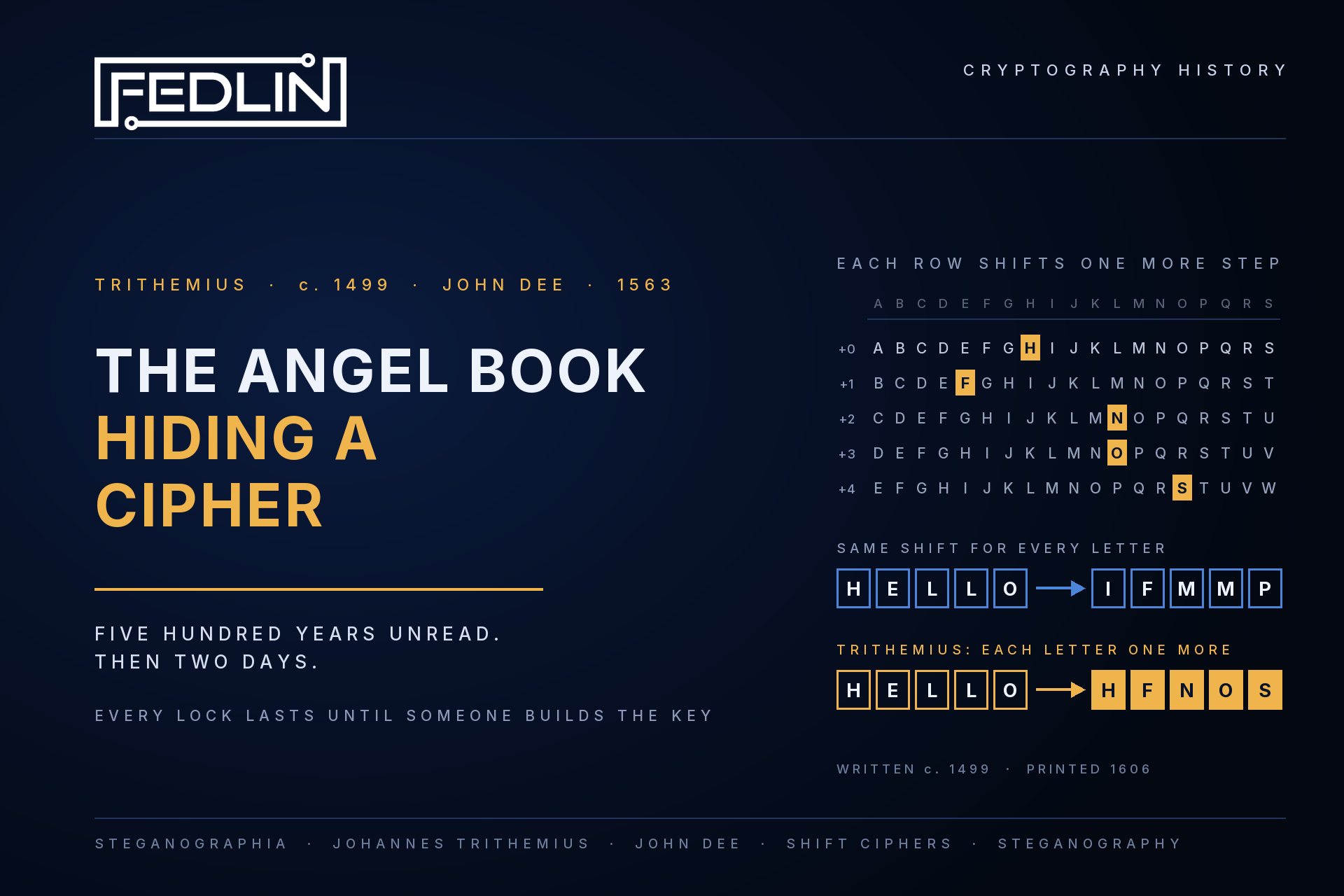
Each "prayer" was also a hidden letter. Read the right letters in the right order and a plain message appeared. Whatever else the angels were, they carried a working cipher.
What a cipher looked like · around 1500
HELLO → IFMMP every letter shifted one step
HELLO → HFNOS Trithemius: each letter shifted one more than the last
Anyone who knows the first rule can shift it back. In a later book, Trithemius made the shift grow with every letter, which hid the pattern far better, and that idea would run through the next four centuries of secret writing.
His title even gave us a word. Hiding a message so no one knows it exists is still called steganography.
Dee Finds the Book
Sixty years later, an Englishman named John Dee found a copy. Dee had his own brush with that label. As a young man at Cambridge he had rigged a flying beetle for a stage play, and by his own account the effect earned him a name as a sorcerer. He spent the rest of his life insisting that marvels like that came from mathematics.
In 1563, traveling abroad, Dee tracked down a copy of the Steganographia, a book others had offered a thousand crowns for and failed to get. He spent ten days copying half of it by hand, then wrote to Queen Elizabeth's chief minister that it was "the most precious juell" he had found. Where others saw witchcraft, Dee saw a tool a nation could use.
The book fit a picture of the world Dee had been building for years. He was also an astrologer, and in 1558 he argued that everything in nature, the stars included, sends out invisible rays that fill the whole universe, measurable with geometry the way light is: weaker the farther they travel, and strongest when they strike straight on.
To Dee, the whole universe was a message written in a hidden language, and mathematics was the key that could read it. He also treasured a strange manuscript called the Book of Soyga: 36 great grids of letters he could never read. Astrology, mathematics, and secret writing were one pursuit for him: reading meaning carried invisibly across distance, which only the right key could unlock. His rays hold up better than his reputation: everything warmer than absolute zero does radiate in every direction, just as he described. He drew that picture centuries before anyone could measure it.
Dee Asks the Angels
Twenty years later, Dee went further than the abbot ever had. From 1582 he sat for long sessions with a scryer named Edward Kelley, who gazed into a polished stone and reported angels speaking. Dee wrote down every word. The sessions ran for years and followed the two men across Europe, where a king and an emperor received them.
What the angels delivered looked a great deal like cryptography. In 1583 Kelley reported a new alphabet of 21 letters. Then came a book of enormous letter grids, each 49 squares across and 49 down, written in what Dee believed was the language Adam spoke before Babel. The angels said every letter could be read 49 different ways, and they never translated the tables. Dee had a secret alphabet, pages of grids, and a go-between who claimed to hold the key.
Kelley gives plenty of reason for doubt, and many historians suspect he wrote much of what the angels said. For Dee, though, the sessions carried on the work of his rays and his ciphers: recovering the hidden language behind nature, so the world could be read the way he read a code.
A century later, Robert Hooke, the scientist who gave cells their name, read the published angel diaries and reached his own verdict. The spirits, their names, their speeches, and their prayers, he told the Society, "are all Cryptography": secret reports for the queen, hidden the way Trithemius taught. Most historians since have judged him wrong. Still, one of the sharpest scientific minds of his age looked at Dee's angels and saw a cipher.
Dee died without reading his angel grids, just as he never read the Book of Soyga. One of those locks has since been opened.
The Code Falls in Two Days
The last part of the book was the hardest. It looked like tables of numbers for reading the stars, and for five centuries nobody could make sense of them.
Then, in the 1990s, two researchers solved it, each working on their own. One of them, a mathematician named Jim Reeds, said it took him about two days. Hidden inside were short messages, including one warning that the person carrying the letter was a rogue and a thief.
After five hundred years, one of the angel book's hidden letters turned out to be a warning about an untrustworthy messenger. The worry was his from the start: untrustworthy messengers are the problem his whole book sets out to solve.
Reeds wasn't finished with Dee's library. He later turned to the Book of Soyga and worked out how its letter grids were made: each one grows, by a fixed rule, from a single seed word. What the grids were meant to say is still a mystery. The method, though, would feel at home in a modern cipher: a short secret, run through a fixed rule, grows into far more scrambled text than anyone could memorize. Your browser repeats the trick every time it connects, stretching a key a few dozen characters long into enough scrambling for an hour of video. Whoever made the Book of Soyga was doing it by hand.
Every Lock Gets Picked
While the abbot's hardest puzzle sat unread, the rest of the world kept building on his ideas. Every few generations someone built a stronger lock, and sooner or later someone else learned to pick it. Read as a story, that back-and-forth says as much about trust as about mathematics: who we were willing to believe, and for how long.
A Keyword Holds for Three Centuries
Trithemius's idea of shifting each letter by a different amount needed a way to agree on the shifts. Half a century later, an Italian scholar supplied one: a keyword. Both sides remember a single word, and its letters set how far to shift each letter of the message. Change the word and the whole message changes. Later nicknamed the indecipherable cipher, it held for about three hundred years.
What a cipher looked like · 1553
HELLO → RIJVS keyword KEY: shift by K, E, Y, then repeat
The two Ls now scramble to different letters, so the word looks like noise. The repeating keyword is also what eventually gave it away.
It wasn't. In the 1800s codebreakers worked out how to read it. The weakness was the keyword itself: because it repeated, it left a rhythm in the scrambled text, and a patient reader could find that rhythm and work backward. Three centuries of confidence ended with a patient reader and a pencil.
The Method Goes Public
The telegraph changed the problem. Messages now crossed a continent in minutes, but they passed through the hands of operators who could read every word. Out of that era came a rule that still governs the field: assume the enemy knows exactly how your system works, and make sure it stays secure anyway. Only the key needs to be secret.
That rule turned Trithemius's world upside down. He kept his method hidden. Modern protection publishes the method and guards only the key, which is why the methods guarding your bank are published openly for anyone to attack.
The Alphabet Goes Mechanical
By the First World War, armies sent too many messages to shift alphabets by hand. Around the end of that war, inventors put Trithemius's idea inside a machine. The best known, Germany's Enigma, used spinning wheels so that every key press shifted the alphabet again.
What a cipher looked like · 1940
HELLO → ILBDA Enigma, one day's machine setting
Every key press turned the wheels, so the two Ls came out as B and D. The machine also never turned a letter into itself, a small flaw that gave the codebreakers a foothold.
Mathematicians found the first cracks before the war, and during it, codebreakers built machines to search for each day's settings faster than any person could. Some of the first electronic computers came out of the wider codebreaking effort. Machines now made the locks, and machines now picked them.
Cryptography Becomes Mathematics
After the war, secrecy became a problem of mathematics. For the first time, you could measure how strong a lock was before an enemy tested it: how much the scrambled text gives away, and how much work it would take to undo.
Then, in the 1970s, researchers solved the problem that had haunted every era since Trithemius: how do two people agree on a key without first sending it through a messenger who might be listening? Their answer let two strangers create a shared secret over an open line, in full view of anyone, without the secret itself ever crossing it.
A second idea from that decade sounds stranger still. Picture a padlock you could hand out freely, to friends and enemies alike, while keeping the only key that opens it. Anyone could seal a box with it and send it through any messenger, and only you could open it. Cryptographers call the padlock a public key and the key you keep a private key. Turned around, the same pair makes a signature: a mark only you could have made, which anyone can check. After five centuries of guarding the messenger, the answer was to stop needing to trust him at all.
The Seal Outlives the Wax
A letter in 1500 also wore a wax seal, so the reader could tell whether anyone had opened it on the road. That seal survives today as a hash, a short fingerprint taken from a message: the same message always leaves the same print, the smallest change leaves a completely different one, and there is no running it backward, only guessing and comparing.
What a fingerprint looks like · SHA-256
HELLO → 3733 cd97 7ff8 eb18 b987 357e 22ce d99f 4609 7f31 ecb2 39e8 78ae 6376 0e83 e4d5
HELLo → 7591 eb0d 9700 bcb8 ced5 f5f0 053c 4b3d f559 a19a a855 f92b a054 f56e a6b2 ec44
Real results. One lowercase letter, and every character of the fingerprint changes. Your password is usually stored this way too: the site keeps the fingerprint and checks yours against it. That guess-and-check route is also why a short, common password can be recovered from a stolen fingerprint, and a long one can't.
The Padlock Arrives
When the public internet arrived in the 1990s, these ideas moved into everyday life. Web browsers began scrambling the connection to a website and checking that the website was the one it claimed to be. That is the little padlock: a shared secret agreed in the open, plus a signature proving who is on the other end. It arrived in the same decade that Jim Reeds finally read the abbot's hidden messages.
What a cipher looks like · today
HELLO → 6eef d584 2b82 61c6 e57c da87 824e a01f AES-256, a random key
A real AES-256 result, written as hexadecimal numbers. Nothing in it hints at the word or its repeated L. Encrypt HELLO again with a new key and every digit changes.
The Oldest Idea Still Does the Work
There is a quiet symmetry in how the modern handshake works: it needs both the abbot's idea and the 1970s one. The shared key is his, a secret both sides hold, old and quick. The key pair is the newcomer, built for strangers but far too slow to carry a whole conversation. So every padlock opens with the newcomer vouching for the website and settling on a fresh shared key, then hands the conversation back to the oldest idea in the book.
When the conversation ends, that shared key is thrown away. There is a kind of humility in the design. It assumes that someday a thief will steal the website's private key, and it makes sure that on that day, yesterday's conversations stay sealed.
Every Key Is a Bet Against Time
The bluntest attack is to try every possible key, and each extra bit doubles the work, so the arithmetic runs away from the attacker quickly. Quickly, until the tools catch up. In the 1990s a 40-bit key, about a trillion possibilities, looked sturdy, and in 1997 a graduate student broke one in about three and a half hours. A 128-bit key today would keep every computer on Earth guessing for billions of years.
The abbot's own book makes the point better than any table of numbers. His hardest puzzle held for five centuries and then fell in two days, once the world had changed around it. A lock that was strong enough when it was fitted keeps getting weaker as the tools for picking it improve.
Every Padlock Starts With a Recipe
Every padlock starts with a short negotiation, in which your browser and the website agree on a recipe for the whole exchange. Engineers call it a cipher suite, and written out, one reads like a timeline of this story: the 1970s ideas first, then the abbot's old shared secret doing the heavy lifting, then the seal.
What a cipher suite looks like
TLS_ECDHE_RSA_WITH_AES_256_GCM_SHA384
- Agree on a secret key in the open, the 1970s idea ECDHE
- Prove who is on the other end with a signature RSA
- Scramble the message and catch any tampering AES_256_GCM
- Seal it: the fingerprint that confirms both sides saw the same handshake SHA384
A real cipher suite, still common on the web. Newer connections use a shorter name, and current versions of Chrome, Edge, Firefox, and Safari add a post-quantum ingredient to the key exchange.
The two sides pick the strongest recipe they both know, and old recipes rarely get thrown away. In the 1990s, US export rules forced software sold abroad to use keys as short as 40 bits. Many servers kept those weak recipes long after the rules were lifted, and in 2015 researchers showed that an attacker in the middle could quietly talk a connection down to them and break it. It was the keyword cipher all over again. Some of those old recipes are still switched on today.
The Padlock Spreads Everywhere
The padlock was only the beginning. Once two strangers could agree on a secret in the open and prove who they were, the same handshake spread far beyond web browsers. It now protects your email on its way between servers, the app on your phone talking to your bank, and the payment terminal at the grocery store. More and more, it also protects connections most people never see: machines at a remote site reporting back to headquarters, a hospital's equipment calling home for updates, a power company's substations talking to its control room.
Every one of those connections is a letter on the road, and every one passes through messengers along the way.
Messengers Fill the Air
Go back to how Trithemius framed his book. He described unseen messengers carrying words through the air to someone far away, faster than any rider. His world read that as angels and sorcery. Read it again today and it describes a phone call.
The strange part is that the air was never empty. Lightning sends radio waves racing around the planet, and it always has. By the 1890s, listeners on long telephone lines heard odd sounds that turned out to come from the sky. During the First World War, soldiers tapping enemy phone lines found those natural whistles loud enough to drown out the conversations they were trying to steal. The signals were there in the abbot's day. Nobody had built anything to hear them.
The physics of 1500 was the physics of 1900. In 1865 James Clerk Maxwell's equations predicted invisible waves traveling at the speed of light, and in 1887 Heinrich Hertz, whose name now measures every radio frequency, made some in his laboratory. The medium for the abbot's messengers had existed all along. His world lacked a transmitter, a receiver, and a way to put words into the wave.
Seen that way, the angel code lines up with a radio link almost piece by piece. The angel is the carrier, the signal that does the traveling. The prayer is the encoding wrapped around it. The spirit's name is the key that tells the reader how to unwrap it. Dee's rays describe a radio signal just as well: weaker with distance, and strongest when it arrives straight on. He had the shape of the problem, centuries before anyone could build the answer.
We now live inside that answer. Wi-Fi in the house, cell towers on the hill, satellites passing overhead: all of them carry our words through the air as signals we can't see, hear, or feel.
Those invisible messengers share one property with the muddy roads of 1500. Anyone nearby with the right receiver can pick up the signal. A radio wave doesn't care who listens. In a sense, every wireless message is a letter handed to every stranger in range, and the only thing keeping it yours is the cryptography wrapped around it.
The password on your Wi-Fi is our answer to that open air. It sets up the shared key that turns everything the router broadcasts into noise for the neighbors, and your phone does the same with every cell tower it passes. The first Wi-Fi protection, from the late 1990s, didn't last: its keys were too weak and too predictable, and researchers learned to crack it in minutes. One more lock trusted a little too long.
The farther a signal travels, from a home router to a remote site's cellular link to a satellite hundreds or thousands of miles overhead, the more strangers it passes. Some of the most important of those messages are the doors that let people reach a system from somewhere else.
The Messenger Is Still the Problem
Think about how work reaches a system today. An engineer logs in from home. A vendor connects to patch a machine. A remote site reports in over a cellular link. Each of those connections travels through messengers: VPN gateways, relays, vendor tools. Cryptography is how the far end knows the messenger is the real one and the message arrived untouched.
When that cryptography goes out of date, the sharpest risk is impersonation. Old protocols, outdated cipher suites, and weak keys let someone stand up a convincing fake gateway, reuse a session that should have expired, or sign in as a vendor who left years ago. The system lets them in because they look right. That is the bolder stranger from 1500, swapping the letter and handing it over as yours.
And as the history shows, the locks themselves keep aging. Systems that run for decades, like the equipment at a remote site, often still use protections that were current when they were installed and have been picked since.
FEDLIN rebuilds that path around a gateway the client owns, ties every session to a named person, and encrypts it with hybrid post-quantum key exchange where both ends support it.
AI Joins the Story
Every lock in this story fell when someone built a better tool for picking it: a patient reader with a pencil for the keyword cipher, machines for Enigma, a network of computers for the 40-bit key. AI is the tool of our own moment, and it reaches every lock at once.
So far, the math holds. The keyword cipher fell because it left a rhythm in the scrambled text, and finding patterns is exactly what AI is good at. Modern ciphers were built with that weakness in mind: done properly, their output looks like random noise, with no rhythm to find. There is no public evidence that AI has broken the mathematics behind today's well-built encryption, and researchers point every new tool at it.
The pressure lands elsewhere. Real failures tend to live around the math: an old setting left switched on, a key stored where it shouldn't be, a program that leaks clues through how long it takes or how much power it draws. Studies have shown machine learning reading secret keys from those tiny variations. In 2026 Anthropic held one of its models, Mythos, back from general release because of how well it finds mistakes like these. With little human help it found thousands of serious, previously unknown flaws across major operating systems and browsers, some hidden for decades. The oldest was a 27-year-old bug in OpenBSD, a system built around security, and more than 99 percent were still unpatched when Anthropic reported the count.
Speed is the bigger change. Turning a known flaw into a working attack used to take a skilled person days or weeks. Mythos did it in under a day, for less than two thousand dollars, starting from nothing more than the flaw's ID number and the code change that fixed it. Across the breaches Mandiant investigated in 2025, attacks on a typical flaw arrived about a week before its patch did. The old locks that once sat unnoticed for years now get found and picked on the attacker's schedule. Every lesson in this story about trusting a lock too long now plays out in days.
The rogue messenger got better too. Cloned voices and realistic video have already talked employees into sending money to criminals. In 1500 a forged letter might be caught by a familiar seal or handwriting. Today those cues can be copied in seconds. A cryptographic signature can't be faked without the key, which is why proving identity with math matters more every year.
And there are new messengers. Companies now let AI agents read files, send messages, and change systems on their behalf, carrying keys and passwords from one system to the next. An agent can be handed a forged letter as well: a web page, email, or document can carry hidden instructions that it follows as if its owner had sent them, a weakness known as prompt injection. That is the bolder stranger from 1500 slipping his own letter into the bag, and the agent delivers it with its owner's keys. The old questions apply: who is this, what is it allowed to touch, and can we see what it did?
The same tools work for the people defending a system, and that has started: AI developers are now putting their strongest models in defenders' hands first, including the firms that protect power and water systems. AI can map where old cryptography still lives across thousands of machines and speed up the long job of replacing it. Like every advance since Trithemius, it serves whoever puts it to work first.
The Next Machine Waits in the Wings
The next chapter is still being written. A new kind of machine, the quantum computer, runs on the rules of physics at its smallest scale, and for a few kinds of math problem those rules offer a shortcut no ordinary computer has. In 1994 a mathematician named Peter Shor showed that one of those problems is exactly the one key pairs rest on. A large enough quantum computer could work out the private key behind a public padlock, and with it read the messages and forge the signatures.
Where that shortcut comes from is one of the strangest open questions in science. David Deutsch, the physicist who first described a universal quantum computer in 1985, argues that the work is shared out across parallel universes. Factoring a large enough number, he reasons, would take far more computing than the visible universe could hold, and he asks: where was the number factorized? In 2024 Google's quantum chip Willow finished a benchmark in under five minutes that would take one of today's fastest supercomputers 10 septillion years, longer than the universe has existed. The head of Google Quantum AI wrote that the result "lends credence to the notion that quantum computation occurs in many parallel universes."
Many physicists read it another way. Scott Aaronson, among others, explains the speedup through interference: the machine arranges its possibilities so that the paths to wrong answers cancel out and the paths to the right one reinforce each other, which is a long way from trying every answer at once. Nobody has settled which picture is true. Either way, the machine that may one day open today's padlocks draws on a layer of reality we can't see directly, which is close to how Dee pictured his angels: messages arriving from a realm beside our own, readable only with the right key.
No such machine exists yet. The quantum computers running today are small and make constant errors, and companies rent time on them mostly for research. None can break a real padlock. Breaking a common padlock key, 2048-bit RSA, is estimated to take under a million qubits, the fragile building blocks these machines run on, working together for about a week. Today's machines are far smaller and far noisier than that.
Nobody knows the day one first will. People call it Q-Day, and two trends are pulling it closer. In 2019 a Google researcher estimated the same attack would take about 20 million qubits, and by 2025 a better method had cut that to under one million. AI has also started helping build the machine: in 2024 Google DeepMind showed an AI model, built on the same design as today's language models, that caught a quantum processor's errors more accurately than earlier methods, and correcting those errors is one of the biggest obstacles to building a large one. Q-Day is being approached from both sides, and the date is still anyone's guess.
Even then, some locks hold. Shared keys and fingerprints lose some of their margin, but a long enough key keeps them safe, and NIST, the agency that sets US encryption standards, doesn't expect to replace them. Five centuries on, the abbot's idea is the one expected to outlast the newest.
The danger also starts before the machine arrives. Anyone can copy sealed letters today and keep them until they can be opened, a practice known as harvest now, decrypt later. For a secret that has to stay secret for ten or twenty years, the window is already open.
So the replacement has begun ahead of time. In 2024 NIST published new post-quantum standards, locks built on math with no known quantum shortcut, and browsers already pair a classic key exchange with one of them. NIST's draft timeline retires the old padlocks after 2030 and forbids them after 2035, and federal agencies now face deadlines of their own. For once in this story, the new locks are going on before the old ones are picked.
Maybe the Code Goes Deeper
Which brings the story back to Dee's instinct. He believed the universe was a message in a hidden language and mathematics was the key. Some of what physics has learned since makes that instinct look less strange than it used to.
In 1961 a physicist showed that information carries a physical price: erasing a single bit, the smallest yes or no a computer can hold, has a minimum cost in heat. In the 1980s another physicist suggested that every particle and field might come, at bottom, from information, from answers to yes-or-no questions. And the machines in the last chapter work because nature itself computes, in ways ordinary machines struggle to imitate, whether that work happens in one world or many. The physics that threatens today's locks is the same physics the world runs on.
Every lock rests on a bet about this universe: that some problems are easy to check and hard to solve, and that the right key is the only shortcut. Nobody has proven that bet. It may be one of the deepest facts about reality, or it may not hold. Dee never settled where that leads, and nobody has since. I believe the challenges we're tackling in the digital space may hold vast implications for how the nature of reality works.
What I Take From the Story
Set the angels and the machines to one side, and five centuries of cryptography come down to a handful of ideas, each one another answer to the abbot's problem of getting a letter past strangers.
Five centuries in six ideas
- A cipher: the abbot's shifting letters, grown into the AES running on your phone.
- A key: the one secret behind the rule. Everything else can be public, and time is its only real enemy.
- A fingerprint: the wax seal, minus the wax.
- A key pair: a padlock you can hand to your enemies, and a signature no one else can make.
- A key exchange: two strangers sharing a secret in a crowded room without ever whispering it.
- A cipher suite: the recipe that ties them together, and like every recipe here, one that ages.
What looks like magic is often a problem someone solved early. Trithemius's puzzle held exactly as strong for five centuries. What changed was the world around it, which finally built the tools to open it. Every lock lasts until someone builds the right key, and the safest systems plan for that day.
Four questions worth asking about any remote connection
- 1.Do you know every way in? VPNs, vendor tools, jump hosts, cellular and satellite links, the forgotten modem in a closet. You can't replace an old lock you don't know about.
- 2.Could the messenger read the letter? A relay or vendor platform should pass your traffic along without holding the keys to it, so that if it is ever taken over, the contents stay sealed.
- 3.Can you tell who is knocking? A shared vendor login could be anyone. When every session belongs to one named person, a stranger stands out, and anything not allowed can be turned away.
- 4.When does each old lock expire? Outdated protocols, cipher suites, and keys rarely get removed on their own. Giving each one an end date, and moving new connections to post-quantum protection where it is available, keeps the locks ahead of the keys.
Trithemius wrote a whole book because he couldn't trust the messenger. Five hundred years later, the messenger is still the right place to start.
Sources
- Jim Reeds, “Solved: The Ciphers in Book III of Trithemius’s Steganographia,” Cryptologia 22(4), 1998
- Gina Kolata, “A Mystery Unraveled, Twice,” The New York Times, April 14, 1998
- Thomas Ernst, “Schwarzweiße Magie: Der Schlüssel zum dritten Buch der Steganographia des Trithemius,” Daphnis 25, 1996
- Charlotte Fell Smith, John Dee (1909)
- John Dee, letter to William Cecil, 16 February 1563, in Philobiblon Society Miscellanies vol. 1 (1854)
- John Dee, A Compendious Rehearsall (1592), in Autobiographical Tracts of Dr. John Dee (1851)
- John Dee, Propaedeumata Aphoristica (1558), ed. Wayne Shumaker, John Dee on Astronomy (1978)
- “Dee, John,” Dictionary of National Biography (1888)
- Deborah E. Harkness, John Dee’s Conversations with Angels (1999)
- Meric Casaubon, A True & Faithful Relation (1659)
- Robert Hooke, “Of Dr. Dee’s Book of Spirits,” in The Posthumous Works of Robert Hooke, ed. Richard Waller (1705)
- Jim Reeds, “John Dee and the Magic Tables in the Book of Soyga,” in John Dee: Interdisciplinary Studies (2006)
- David Kahn, The Codebreakers (rev. ed. 1996)
- Simon Singh, The Code Book (1999)
- Auguste Kerckhoffs, “La cryptographie militaire” (1883)
- Crypto Museum, “How Enigma works”
- Claude Shannon, “Communication Theory of Secrecy Systems” (1949)
- Whitfield Diffie and Martin Hellman, “New Directions in Cryptography” (1976)
- UC Berkeley, Ian Goldberg breaks RSA’s 40-bit challenge (1997)
- Logjam: “Imperfect Forward Secrecy” (2015)
- Matthew Green, “Attack of the week: FREAK” (2015)
- Cloudflare, post-quantum support by browser
- NIST FIPS 203, 204 and 205 (2024)
- James Clerk Maxwell, “A Dynamical Theory of the Electromagnetic Field” (1865)
- Heinrich Hertz, Electric Waves (1893)
- Heinrich Barkhausen, “Zwei mit Hilfe der neuen Verstärker entdeckte Erscheinungen,” Physikalische Zeitschrift 20, 1919
- Reiner Stenzel, “Whistler waves in space and laboratory plasmas” (1999)
- Tews, Weinmann and Pyshkin, “Breaking 104 bit WEP in less than 60 seconds” (2007)
- Anthropic, “Claude Mythos Preview” research report (2026)
- Mandiant, M-Trends 2026
- Maghrebi, Portigliatti and Prouff, “Breaking Cryptographic Implementations Using Deep Learning Techniques” (2016)
- CNN, Arup deepfake scam (2024)
- OWASP, “LLM01: Prompt Injection”
- Peter Shor, “Polynomial-Time Algorithms for Prime Factorization and Discrete Logarithms on a Quantum Computer” (1994)
- David Deutsch, “Quantum theory, the Church-Turing principle and the universal quantum computer” (1985)
- David Deutsch, The Fabric of Reality (1997)
- Hartmut Neven, “Meet Willow, our state-of-the-art quantum chip,” Google (2024)
- Scott Aaronson, “Why Philosophers Should Care About Computational Complexity” (2011)
- Michael Cuffaro, “The Philosophy of Quantum Computing” (2021)
- Craig Gidney and Martin Ekerå, “How to factor 2048 bit RSA integers in 8 hours using 20 million noisy qubits” (2019)
- Craig Gidney, “How to factor 2048 bit RSA integers with less than a million noisy qubits” (2025)
- Bausch et al. (Google DeepMind), “Learning high-accuracy error decoding for quantum processors,” Nature (2024)
- NIST IR 8547 (initial public draft), “Transition to Post-Quantum Cryptography Standards” (2024)
- Rolf Landauer, “Irreversibility and Heat Generation in the Computing Process” (1961)
- John Archibald Wheeler, “Information, Physics, Quantum: The Search for Links” (1989)
Do you know every way into your systems?
FEDLIN maps every remote path, from VPNs and vendor tools to cellular links, then rebuilds access around named identities, keys the carrier never holds, and a dated schedule to retire old cryptography. You get the evidence to show it.
Subscribe to Security Insights
Get enterprise security tips, compliance guides, and best practices delivered to your inbox.