What the 2030 Federal Encryption Deadline Means for Your Contracts
A June 2026 executive order set hard 2030 and 2031 deadlines for moving federal systems to quantum-resistant cryptography, with acquisition rules written to pull in the contractors who serve them. In plain terms: what it means, the move to make now, and the first steps to get ahead.
The short version
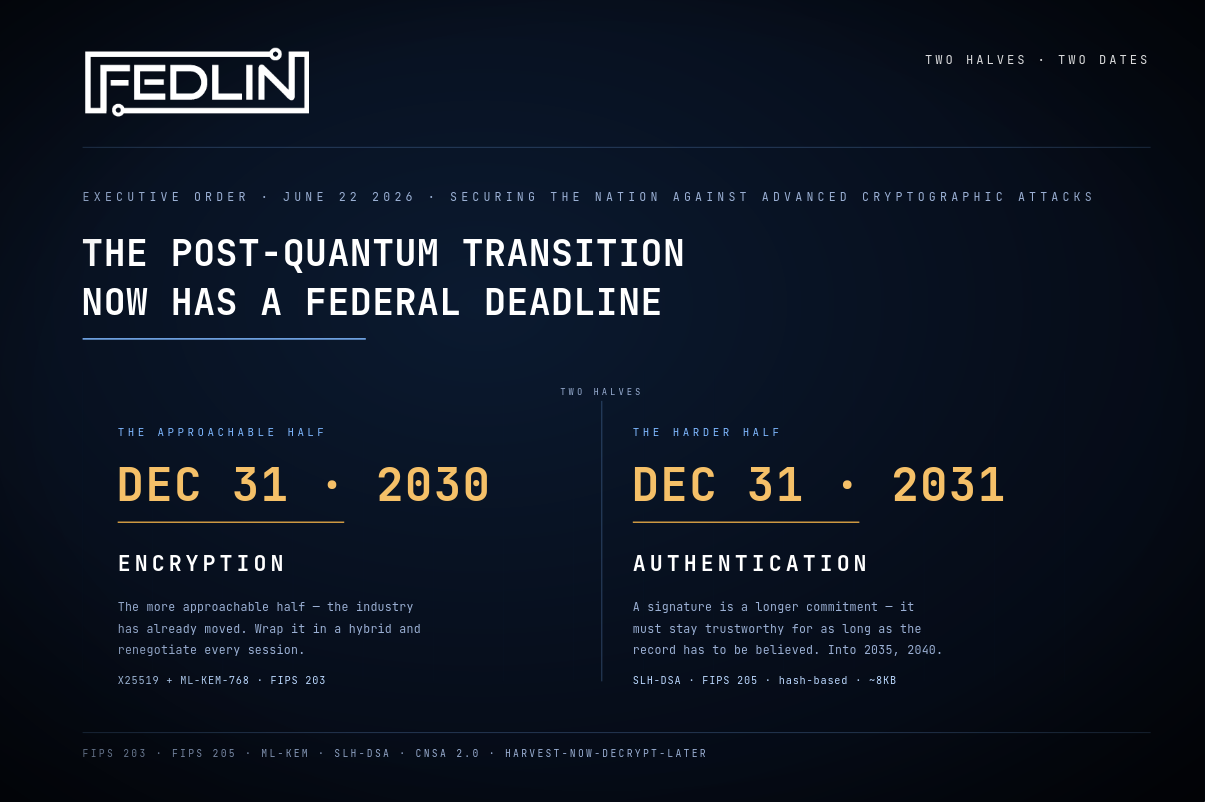
- 1.The deadlines are real and dated. Post-quantum encryption on sensitive federal systems by the end of 2030; authentication by the end of 2031.
- 2.It reaches contractors, not just agencies. If you sell to the government, directly or as someone's subcontractor, the same 2030 standard is heading for your contracts.
- 3.The first move is small, and it starts now. Inventory the cryptography you actually run, then sequence the migration: the work is bounded, and it can be taken in order.
On June 22, 2026, the White House issued Executive Order 14412,Securing the Nation Against Advanced Cryptographic Attacks. It sets the first hard federal deadlines for moving to post-quantum cryptography, the new cryptographic standards NIST finalized in 2024. The government's most sensitive systems have to meet that standard for the data they move by December 31, 2030, and the digital signatures behind authentication by December 31, 2031. And it isn't aimed only at agencies, it's written to reach the contractors who serve them too. A shift that had lived quietly in standards and advisories since 2024 is now a dated obligation.
The core standards are finished and the deadlines are set. What's left is the work of moving real systems onto the new cryptography without breaking them. Three things have to change: the handshake that protects data as it moves, the government-approved foundation that handshake has to sit on, and the digital signatures that keep long-lived records trustworthy. What follows is a plain walk through each one: what each involves, and how far along it already is: front-door encryption largely handled, the approved foundation available now, and the connections behind them still catching up.
Why this reaches contractors, not just agencies
Two dates anchor the order: post-quantum encryption on sensitive federal systems by the end of 2030, and post-quantum authentication by the end of 2031. The part that travels furthest is the reach beyond government's own networks. The order directs the federal acquisition rules to be updated so covered contractors are held to the same 2030 standard: the exact wording is still being written, but the direction is set: this is meant to land on the companies that sell to the government, not only on agencies. And because acquisition requirements pass down the supply chain, the reach doesn't stop at the big primes: a smaller company with no federal contract of its own can still find the same requirement written into a purchase order from a customer that has one. National-security systems run on a separate, earlier clock of their own.
And the deadline that actually arrives first is neither headline date. Within 120 days of the order, each agency owes the White House budget office a written migration plan: a phased schedule out to 2035, with a requirement that systems be built so the cryptography can be swapped out later without tearing everything down. What any one agency or contractor must do, and by when, is a program question for the advisers who own that layer. This piece stays on the ground underneath it: what these changes actually involve, from having built them.
The clock has already started
In a 2023 advisory, CISA, NSA, and NIST warned that adversaries are already collecting encrypted data now, planning to decrypt it later once a quantum computer that can break today's encryption arrives. Security teams call this harvest now, decrypt later, and it changes the math on the deadline: anything that must stay confidential into the 2030s is effectively exposed the moment it is sent today. The clock is really about the shelf life of your secrets.
Keep three facts straight
- Quantum breaks today's public-key cryptography: RSA, Diffie-Hellman, and elliptic curve, the math behind secure connections and digital signatures. It doesn't break the symmetric encryption and hashing underneath most of what you run.
- The everyday encryption that protects your stored data is far less affected: a quantum computer only halves a symmetric key's strength, it doesn't break it. So the move here is simply to run the strongest symmetric standard the guidance calls for, AES-256, not AES-128.
- A quantum computer that can do this isn't here yet: expert estimates cluster in the 2030s but carry wide uncertainty both ways. That's the point: you can't time it, and data captured today can be unlocked the day it arrives.
Encryption: the hard part is mostly handled
The 2030 encryption deadline is the more manageable of the two, because the industry already did the hardest part. When a browser opens a secure connection, it first runs a quick handshake to agree on a shared key, and that key agreement is the piece most exposed to a future quantum computer. Modern edge platforms have already upgraded it: for an up-to-date browser, the handshake now combines today's proven method with a new quantum-resistant one (the standard NIST calls ML-KEM), while older browsers still connect normally. Pairing the two is deliberate: if either is ever broken, the other still holds, so there's no gamble in adopting it early. On modern platforms, that upgraded handshake is switched on at the edge today.
The catch worth knowing before anyone declares the job done: that upgrade covers only the front door: the public-facing connection. A real system has many more connections behind it, between its own servers and management layers, and each one is a separate upgrade, several of which the tools are only now catching up to. "Protected at the edge" and "protected across the whole path" are very different claims, and the distance between them is where most of the real work lives. The only way to know which one you actually have is to check each connection directly, rather than trust a vendor's release notes. The companion piece on thefour NIST algorithmscovers what is ready to deploy today.
The approved foundation underneath
Choosing a quantum-resistant algorithm is not the same as being approved to use it for federal work. For federal work, the algorithm has to run inside a building block the government has formally tested and approved, a FIPS-validated module, and those approved versions are only now arriving. The older approval standard, FIPS 140-2, moves to NIST's historical list in September 2026, still fine for systems already using it, but not for anything built from here on, which makes the current standard, FIPS 140-3, the path forward. This is exactly what the coming contractor rules point at: meeting the government's standard, not merely naming a good algorithm: the reason a serious migration turns that FIPS mode on from the first boot rather than bolting it on later.
Turning that mode on isn't a checkbox. It shuts off every method the government hasn't approved, which means rebuilding each affected part of the system on approved cryptography before it will run again. The payoff is that the foundation is then ready: when the post-quantum building blocks ship, adding them becomes a small, incremental step rather than another rebuild, as long as the system was designed so its cryptography can be swapped without disturbing everything around it. That property has to be designed in from the start. I ran a full FIPS 140-3 rebuild on my own infrastructure to test exactly this. Written up separately.
Signatures: the longer commitment
The 2031 deadline is the harder one, because a signature is a longer promise than encryption. Encryption can be renegotiated on every connection, but a signature is a long promise: whatever signs a record has to stay trustworthy for as long as that record must be believed, and some records still have to hold up in 2035 or 2040. The hash-based standard NIST published, SLH-DSA, fits this job well: its security rests on a different, more conservative mathematical foundation than the faster alternatives. NIST deliberately released two independent options so the whole ecosystem would not depend on a single assumption; if the faster family is ever weakened, hash-based signing still stands.
That safety has a price: these signatures are larger and slower to produce, which makes them a poor fit for high-volume, split-second sign-ins and an excellent fit for a record signed once and verified a decade later. So the real design question is which one fits each job: long-lived records on the conservative option, high-volume authentication on the faster one. The signing-layer architecturecovers the key-management side of that choice.
The two tracks at a glance
| Encryption · by 2030 | Signatures · by 2031 | |
|---|---|---|
| What it protects | Data as it moves: the handshake that sets up a secure connection | Trust in a record: proof of who signed it, and that it is unaltered |
| Exposed to "harvest now, decrypt later"? | Yes: data captured today can be opened later | No: a signature can't be forged after the fact, so this move is deliberate, not an emergency |
| Where it stands | Largely handled at the modern edge; internal connections still maturing | The longer migration; hash-based signing is the mature, conservative option |
| The move | Hybrid key establishment, the new ML-KEM standard alongside today's | Match the tool to the job: long-lived records on hash-based signing, high-volume sign-ins on the faster option |
Not sure which of these already runs in your environment? The first step is a clear look at what you have.
Start with a readiness assessmentThe deadline lands hardest on the smallest teams
A federal mandate is written once and applies to everyone under it: the agency with a full cryptography team, and the office where one person is the security officer, the IT lead, and the privacy officer all at once. Both get the same deadline. The clock does not scale down for the smaller shop, and neither does the harvest-now risk: a two-person office holds data with a long confidentiality horizon just as a large one does. The reassuring part is that the work is bounded, and it can be taken in order.
What to do first
Meeting the date is a finite, sequenced project, not an open-ended one. For a typical migration, it runs in this order:
Inventory what you actually run. Produce a cryptographic inventory, a CBOM, of where the quantum-vulnerable methods live and what they protect. You cannot sequence a migration you cannot see.
Confirm the front door. The edge handshake is very likely already handled by the platform your site runs on. Verify it, then set it aside.
Set the approved foundation once. Move to FIPS-validated building blocks, and design the system so algorithms can be swapped later without a rebuild. That single decision makes everything after it incremental.
Sequence the migration. Rank each finding by how soon it breaks and how long its data must stay secret, then work the list: highest-risk connections and longest-lived records first.
The service built for this
Knowing where you stand is the easy half; the hard half is the distance between that report and a real, approved, quantum-resistant control running in production. That distance is the demand this order creates: the 120-day planning clock, the contractor rules reaching past agency networks, and a mandate that hands the two-person office the same date as the largest agency all come down to one need: someone to take a live environment from "we're not fully sure what we're running" to a validated, sequenced plan.
And it isn't only a federal problem. Harvest-now-decrypt-later doesn't check whether you hold a government contract, and any organization sitting on data that has to stay private for years carries the same exposure, and private companies selling upmarket are starting to meet the question in their customers' security reviews. The mandate is just the version with a date attached; the work underneath is the same.
FEDLIN'spost-quantum readiness serviceis open for exactly that work, and the discovery stays inside your own environment so the map of your cryptography never leaves it. The engagement can start with a single system you nominate, in your own boundary, then work through the rest of what you run:
- →Discovery & CBOM. A validated inventory of the cryptography you run: a machine-readable crypto bill of materials, the kind of inventory regulators are starting to expect, in the widely used CycloneDX CBOM format.
- →Crypto-agility architecture. The system designed so algorithms can be swapped later without a rebuild.
- →The standards the order points to. Hybrid key establishment (ML-KEM) and signing (SLH-DSA), built to the FIPS 203 and 205 standards.
- →A phased migration plan. Every finding ranked and sequenced against the 2030 and 2031 dates.
You don't have to have your cryptography mapped to start: that's the part I take on. I built and ran this discovery pipeline on my own infrastructure, under an active FIPS provider, and it runs inside your boundary, so what comes back is a machine-validated inventory you keep. The organizations that clear these dates without drama will be the ones that started while the deadline was still years away.
Sources: The White House, Executive Order 14412: Securing the Nation Against Advanced Cryptographic Attacks (June 22, 2026); OMB, Memorandum M-26-15, Execution of the Migration to Post-Quantum Cryptography (June 24, 2026); Cloudflare, on the post-quantum executive order.
You don't have to take this on alone.
The deadline is real, but the work is bounded and it goes in order. You don't have to have it mapped to start. We begin with a clear picture of what you're running (a CBOM) and a plan sequenced to the 2030 and 2031 dates. Then we do the specialist crypto-engineering, inside your own environment and alongside your team, a piece at a time.
Subscribe to Security Insights
Get enterprise security tips, compliance guides, and best practices delivered to your inbox.