Post-Quantum Signing for Blockchain Integrity Records: Building for Cryptographic Longevity
Blockchain makes a record permanent. Whether that record still proves document integrity in 2035 depends on what happened before it was anchored: who signed it, how the signing key was controlled, and whether the signing algorithm survives quantum computing.
Proving that a document hasn't been changed is a harder problem than it looks. The document can sit unchanged for years, then be altered quietly: a date, an amount, a clause. Without a record created at the moment of signing, there's nothing authoritative to compare against later.
Blockchain integrity systems solve this by creating a permanent record at the moment of signing. The document gets converted into a fixed-length fingerprint, unique to that exact version of the file, and that fingerprint gets recorded as an immutable transaction on a public blockchain. Anyone can later regenerate the fingerprint from the same document and compare it against the on-chain record. If the document was changed after signing, the fingerprints won't match. No single party controls the record.
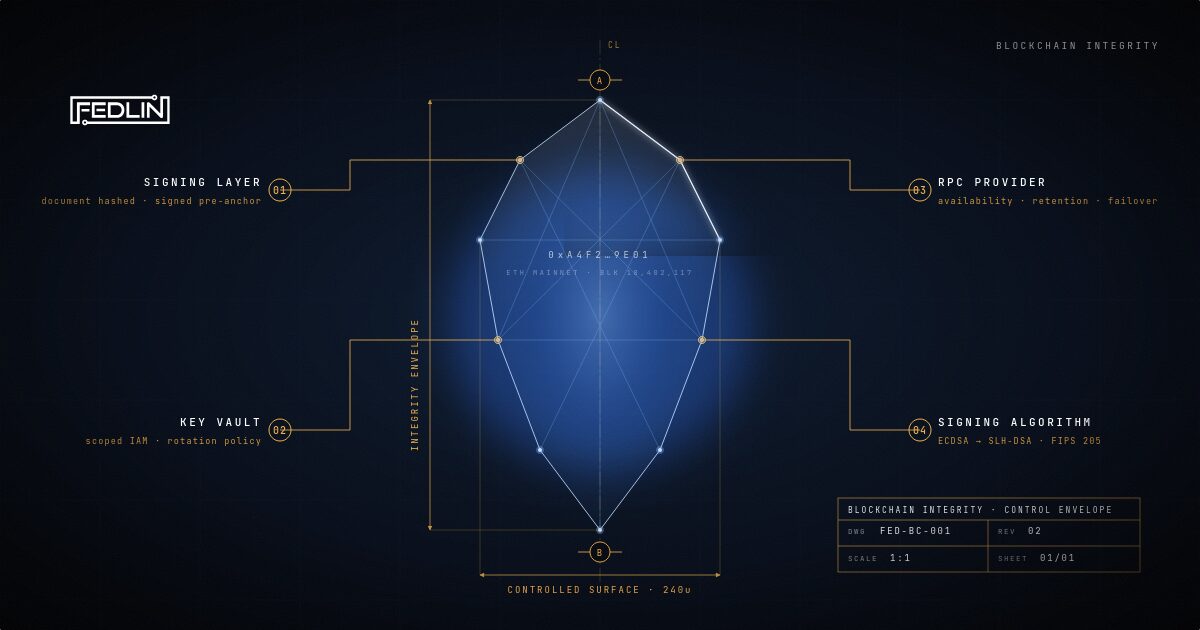
The signing infrastructure that feeds the chain is where the security architecture actually lives: the key that produced the fingerprint, the algorithm used to sign it, and the controls around who can invoke the signing operation. Getting that layer right is the architectural work.
What the Chain Actually Guarantees
The chain's value proposition of immutability, tamper-evidence, and public verifiability is well-established. What matters here is where those guarantees end, because that boundary is exactly where the security architecture begins.
What the chain guarantees
- Immutability of the stored record
- Tamper-evidence: any modification to the record is detectable
- Public verifiability without a trusted intermediary
- No single party controls the record
What the chain doesn't guarantee
- Anything about what was signed
- The identity or authority of who signed it
- Whether the signing key was properly managed
- Whether the signing algorithm will remain secure over the record's lifetime
That line between what the chain guarantees and what it doesn't is where security architecture begins. Everything below it is yours to build and maintain.
The Signing Layer: Where the Real Security Lives
Walk through the integrity flow as it actually happens in a document integrity system:
Document fingerprinted
A cryptographic hash of the document is produced: a fixed-length fingerprint unique to that exact document content.
Hash signed with private key
The hash is signed using the service's private signing key. The signature proves the signing party had access to the key at that moment.
Signed hash submitted as transaction
The signed hash is submitted to the blockchain as a transaction. The transaction is confirmed and included in a block.
Transaction ID stored as the integrity reference
The on-chain transaction ID is stored alongside the document. Verification later means: hash the document, verify the signature, confirm the hash matches the on-chain transaction.
The chain is only as trustworthy as the signing layer that feeds it. Two specific failure modes that break the integrity system entirely:
Signing key compromise
If the signing key is compromised, signatures can be forged. A forged signature anchored on an immutable chain is permanently there, and it permanently appears to be a valid integrity proof. The immutability that makes the chain valuable becomes a liability when the underlying signature is fraudulent.
Signing algorithm broken by quantum computing
If the signing algorithm is eventually broken by quantum computing, historical signatures become forgeable. The hash stays on-chain, immutable, exactly where it was placed. But a quantum-capable adversary could produce a forged signature that looks indistinguishable from a valid one. The integrity record appears intact, but the proof connecting document to hash can no longer be trusted. For long-term anchoring, this makes signing algorithm selection an architectural decision, not a future migration.
Both failure modes are preventable. Neither requires exotic controls. They require a signing layer designed with these risks in mind.
Key Management Controls
The private signing key is the most critical asset in the system. These are the design questions that determine whether the architecture is trustworthy over time.
Where does the key live?
A secrets manager (GCP Secret Manager, AWS Secrets Manager, or HashiCorp Vault) with access scoped to a dedicated service account. Every other storage location (config files, environment variables in repositories, developer workstations) creates exposure that doesn't belong in a production signing system. The answer should be a secrets manager with scope-limited service account access.
Who or what can invoke signing?
Least-privilege service account, IAM-governed, with every access event logged via cloud audit logs. Signing should require the same rigor as any other high-privilege operation in the system: no direct human invocation without an audit trail.
How is the key rotated?
Key rotation for a signing system is more complex than for an encryption key: old signatures need to remain verifiable under the key version that produced them. A rotation policy needs a defined schedule, documented procedures, and a clear plan for verifying historical signatures after each rotation.
What happens if it's compromised?
Which signatures would need to be re-evaluated or re-issued? Who gets notified, and on what timeline? The incident response procedure for key compromise should be documented and tested before it's needed. The answer to these questions is harder to construct during an active incident.
None of these questions are difficult to answer when the key management architecture is designed deliberately.
RPC Provider Dependencies
Every Ethereum-based system relies on an RPC provider to interact with the chain. Alchemy, Infura, QuickNode: these services handle the interface between your application and the blockchain network. They're infrastructure dependencies, and they deserve the same deliberate assessment as any other critical dependency.
Questions worth having answered about your RPC provider:
- Availability: What happens to your anchoring pipeline if the provider has an outage? Is there a fallover path, or does the signing queue simply back up?
- Data retention: Does your provider log transaction data? Does that create any data retention considerations for your use case, particularly for systems handling sensitive or regulated document content?
- High-assurance path: For applications where the RPC provider dependency is a material risk, such as compliance-critical use cases or high-value document integrity, is there a path to running your own node? That eliminates the third-party dependency entirely.
Alchemy and Infura are SOC 2 certified, solid infrastructure choices with appropriate compliance posture. They're a dependency that deserves a conscious decision. Understanding the failure mode of a dependency before it fails is the baseline of good architecture.
Post-Quantum Signing: The Architectural Decision for Long-Lived Records
ECDSA is efficient, widely supported, and breakable by quantum computers once they reach sufficient scale. For applications with short-lived signatures, the quantum timeline (credible estimates put it at 5–15 years or more) means migration can be addressed when it becomes urgent. Long-lived document integrity records are the specific exception.
A document signed and anchored today may need its integrity verified in 2035 or 2040. If ECDSA is broken by then, the signature proves nothing. The fingerprint is still on-chain, immutable, verifiable, exactly where it was placed. The proof connecting the document to that fingerprint is no longer cryptographically valid. For long-term integrity anchoring, signing algorithm selection is an architectural decision from the start.
SPHINCS+ (now FIPS 205 / SLH-DSA) addresses this directly. A few points worth understanding:
Security assumptions
SPHINCS+ security rests on hash function properties, specifically that they're one-way and collision-resistant. Quantum computers can partially weaken hash functions but can't break them the same way they break the math behind ECDSA. The mathematical foundation is fundamentally different, and that difference is the point.
Signature sizes: the tradeoff worth understanding
A SPHINCS+ signature is roughly 8KB. An ECDSA signature is 64 bytes. That size difference rules SPHINCS+ out for high-throughput signing: API authentication, encrypted connections, per-request operations. For document integrity anchoring, where signing happens once at document creation, the size difference has no meaningful effect on system performance.
Stateless by design
Stateful hash-based schemes like XMSS and LMS require careful state management: each signing key can only be used once, and reusing a state key catastrophically breaks the scheme. SPHINCS+ is stateless: each signature is generated independently with no state tracking. That makes it significantly safer to implement in production without the operational risk of state mismanagement.
NIST standardized alongside lattice-based schemes deliberately
NIST published SPHINCS+ alongside two other post-quantum standards specifically so the security of the whole system doesn't rest on a single mathematical assumption. If a weakness in the other algorithms is discovered, SPHINCS+ remains secure because it's built on completely different math. For blockchain integrity records that need to hold up over a decade or more, that's the architecturally conservative choice.
Building for the Long Term
Long-term trustworthiness in a blockchain integrity architecture comes from a specific set of design properties. Here's what to look for:
Crypto-agility
The signing layer should be abstracted from the application architecture. When FIPS 205 is eventually superseded, or when a different algorithm becomes the preferred choice for a specific use case, the system should be able to migrate the signing algorithm without rebuilding surrounding infrastructure. Crypto-agility is a design property, not something that can be easily added after the fact.
Key versioning
Key versioning is what makes rotation safe: old signatures remain verifiable under the version that produced them, new signatures use the current key, and the system tracks which version was active at any given time. Verification works correctly regardless of how many rotations have occurred.
Chain selection for longevity
Ethereum mainnet has a decade of production history as an immutable ledger, with the smart contract capability that makes application-layer integrity verification practical at scale. Testnets are appropriate for development and validation. Records that need to be verifiable in a decade belong on mainnet, where long-term availability is part of the network's design.
Off-chain documentation
The on-chain transaction proves a hash existed at a point in time. Without documentation, that record becomes increasingly difficult to interpret as time passes: which document, under which key version, with which algorithm, at which parameter set. The off-chain documentation that maps the transaction to those details is part of the architecture. Without it, a decade-old integrity record may be technically valid but practically unverifiable.
See the blockchain compliance architecture section above for more on how these properties map to SOC 2 and compliance requirements for Web3 systems.
Sources
Built something on blockchain infrastructure?
FEDLIN builds and assesses security architecture for blockchain integrity systems, covering the signing layer, key management controls, and GRC-ready evidence artifacts. Schedule a consultation to review or build the architecture.
Schedule a ConsultationRelated
Working with clients on NIST 800-53 or NIST CSF remediation?
FEDLIN handles the implementation layer: controls deployed, evidence wired, artifacts ready before the audit window opens.
Subscribe to Security Insights
Get enterprise security tips, compliance guides, and best practices delivered to your inbox.