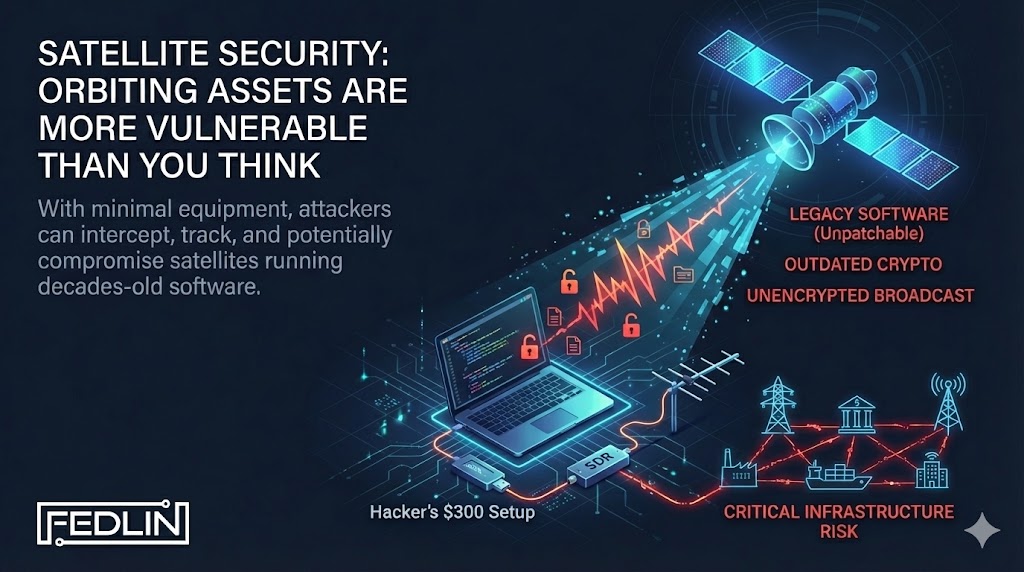
Satellite Security: Why Orbiting Assets Are More Vulnerable Than You Think
With minimal equipment, attackers can intercept, track, and potentially compromise satellites running decades-old software.
⚖️ Disclaimer: This article is for educational and awareness purposes only. The information presented is intended to help security professionals, researchers, and organizations understand satellite vulnerabilities so they can better defend critical infrastructure. We do not endorse, encourage, or condone using this information for unauthorized access, interception, or any illegal activity. Unauthorized interference with satellite systems violates federal and international law.
2003: A commercial communications satellite launches into geostationary orbit. It's state-of-the-art for its time—encrypted command channels, secure firmware, redundant systems. The engineering team spent years designing it. The encryption standards were cutting-edge. The satellite is expected to operate for 15 years, maybe 20.
2026: That same satellite is still in orbit, still operational, still handling critical communications. But the encryption it uses? Considered broken by modern standards. The firmware? Never patched. The security assumptions from 2003? They don't account for attack techniques that didn't exist then—or for the $300 software-defined radio kits that can now intercept its signals from a backyard.
This isn't a hypothetical. Thousands of satellites launched in the 2000s and early 2010s are still operational today, running software and security protocols that are decades out of date. And there's no patch coming.
The Uncomfortable Truth About Space Security
We tend to think of satellites as untouchable—orbiting hundreds or thousands of miles above Earth, safely out of reach. The reality is far more concerning.
Many satellites in orbit today can be intercepted, tracked, and in some cases accessed using equipment that costs less than a used car. Some are running software written decades ago, with known vulnerabilities that will never be patched. Others broadcast unencrypted data that anyone with the right antenna can receive.
⚠️ Key reality: The barrier to entry for satellite hacking isn't a nation-state budget. It's a software-defined radio, an antenna, and the willingness to learn.
The $300 Satellite Hacking Kit
Security researchers have demonstrated satellite interception using surprisingly affordable equipment:
- • RTL-SDR dongle (~$30)
- • Directional antenna (~$50-200)
- • Low-noise amplifier (~$20)
- • Laptop with GNU Radio
- • Publicly available decoders
- • Weather satellite imagery
- • Ship tracking (AIS) data
- • Aircraft surveillance (ADS-B)
- • Unencrypted telemetry
- • Some voice/data comms
At DEF CON and Black Hat, researchers have repeatedly shown how to intercept satellite communications, decode proprietary protocols, and in some cases, interact with satellite systems using equipment you could buy on Amazon.
Frozen in Time: The Legacy Software Problem
Here's the fundamental challenge: once a satellite is in orbit, you can't exactly send a technician up to patch it.
Many operational satellites are running software and firmware that was finalized years before launch—and launches themselves can take a decade from design to orbit. This means:
- !Outdated cryptography: Satellites launched in the 2000s may use encryption standards now considered broken. Upgrading isn't always possible.
- !
- !No secure boot: Older satellites may lack hardware-based security features we now consider essential, like secure boot or trusted execution environments.
💡 A satellite launched in 2010 might be running software designed in 2005, with security assumptions from 2003. That's over two decades of vulnerability research it can't defend against.
Broadcasting in the Clear
It's not just legacy systems. A surprising number of satellites—including some launched recently—transmit data with little or no encryption.
Why? Several reasons:
- Regulatory requirements: Some satellite services (like weather data) are mandated to be publicly accessible.
- Processing overhead: Encryption requires compute resources. In power-constrained satellites, every watt matters.
- "Security through obscurity": Operators assumed proprietary protocols would stay secret. They didn't.
- Cost pressure: Security adds complexity and expense. Commercial operators may prioritize other concerns over security.
The result: ship locations, aircraft positions, industrial telemetry, and even some voice communications are being broadcast across the planet for anyone to receive.
This Isn't Theoretical
Satellite security incidents have moved from conference demos to real-world attacks:
Attackers deployed wiper malware that bricked tens of thousands of satellite modems across Europe at the start of Russia's invasion of Ukraine. The attack exploited vulnerabilities in the satellite network's management infrastructure.
Researchers have documented cases where unauthorized parties have interfered with commercial satellite signals through jamming or signal overpowering—demonstrating that physical access to ground infrastructure isn\'t always required to disrupt satellite communications.
Security researchers have repeatedly demonstrated intercepting satellite internet traffic, decoding satellite phone calls, and even sending spoofed commands to satellites—using equipment costing under $1,000.
Documented GPS manipulation has affected commercial aviation and maritime navigation near conflict areas, demonstrating that attacking space-based systems has real-world consequences.
Why This Won't Get Better Quickly
Unlike a web server you can patch overnight, satellite security faces unique constraints:
- • Limited uplink bandwidth for updates
- • Risk of bricking assets in orbit
- • No physical access for recovery
- • Legacy hardware can't run new crypto
- • 15-20 year operational lifespans
- • Large satellites can cost $100M-$1B+
- • Security wasn't in original design
- • Insurance doesn't cover cyber
- • No regulatory teeth (yet)
- • Replacement takes years
The satellites being launched today will still be operating in 2040. The security decisions being made now—or not made—will echo for decades.
Why This Matters Beyond Space
Even if you don't operate satellites, you depend on them:
- GPS/Navigation: Logistics, aviation, shipping, emergency services, and your phone's maps all depend on satellite positioning.
- Timing: Financial transactions, power grid synchronization, and cellular networks rely on satellite-derived time.
- Communications: Remote areas, maritime, aviation, military, and disaster response all use satellite links.
- Critical Infrastructure: SCADA systems, pipelines, and utilities often use satellite backhaul for remote monitoring.
💡 The implication: A successful attack on satellite infrastructure isn't just a space problem—it cascades into everything that depends on it.
What Can Be Done: Hardening the Attack Surface
While you can't patch satellites already in orbit, there are practical steps organizations can take to harden both the satellite infrastructure itself (for new deployments) and the ground systems that depend on them. Here's what can be deployed to mitigate modern attack vectors:
Satellite-Level Hardening: What Can Be Done on the Satellite Itself
The security features available on a satellite depend on what was built into it. For satellites already in orbit, you're limited to configuring what the hardware and firmware support. Here's what can be hardened at the satellite level:
- • Command signatures: If supported, require cryptographic signatures for all commands
- • Command whitelisting: Configure the satellite to only accept specific, pre-approved commands
- • Command validation: Enable onboard validation to reject malformed or unauthorized commands
- • Access control lists: If the satellite supports it, configure which ground stations can send commands
- • Command rate limiting: Limit how frequently commands can be sent to prevent flooding
- • Telemetry encryption: Enable encryption for downlink data if the satellite supports it
- • Command encryption: Encrypt uplink commands to prevent interception
- • Key management: Configure and rotate encryption keys if the satellite has key management capabilities
- • Data integrity checks: Enable checksums or cryptographic hashes to detect tampering
- • Secure storage: If the satellite stores sensitive data, ensure it's encrypted at rest
- • Firmware updates: If the satellite supports over-the-air updates, apply security patches when available
- • Secure boot: If hardware supports it, enable secure boot to verify firmware integrity
- • Software hardening: Disable unused services and features to reduce attack surface
- • Firmware signing: Ensure only signed firmware can be loaded (if supported)
- • Version control: Track firmware versions and maintain ability to rollback if needed
- • Frequency hopping: If supported, enable spread spectrum techniques to resist jamming
- • Signal authentication: Configure the satellite to verify legitimate ground station signals
- • Anti-spoofing: Enable features that detect and reject unauthorized command attempts
- • Redundant links: Use multiple communication paths if the satellite supports them
- • Safe mode: Configure automatic safe mode activation if anomalies are detected
⚠️ Reality check: Many legacy satellites don't support these features. Older satellites may have no encryption, no command authentication, and no way to update firmware. In these cases, all security must be handled at the ground control level and through application-layer encryption. The satellite itself becomes a "dumb pipe" that you must protect from the ground up.
For satellites that do support these features, the key is proper configuration. Some satellites may have security features that need to be properly configured after launch, or may have been deployed with weaker security settings than modern best practices recommend. Review the satellite's security capabilities and enable/configure them appropriately. This might require working with the satellite manufacturer or consulting the technical documentation.
For small satellites or DIY rigs (like CubeSats), the same principles apply: enable encryption if your hardware supports it, implement command authentication, use secure boot if available, and configure the satellite to reject unauthorized commands. Even basic satellite hardware can have some level of security if properly configured.
Ground Infrastructure Hardening
For existing satellite-dependent systems, focus on securing what you can control—the ground infrastructure:
- • Firewall rules: Restrict ground station access to authorized IPs only
- • Network segmentation: Isolate satellite links in separate VLANs or network zones
- • Intrusion Detection Systems (IDS): Monitor for unauthorized access patterns
- • VPN/Encrypted tunnels: Mandatory encryption for all satellite backhaul traffic
- • Zero Trust architecture: Verify every connection, even from trusted networks
- • Multi-factor authentication (MFA): Required for all ground station access
- • Role-based access control (RBAC): Limit who can configure satellite systems
- • Privileged access management: Monitor and audit administrative actions
- • Session management: Timeout inactive connections, rotate credentials
- • Audit logging: Track all access attempts and configuration changes
Application & Data Layer Security
- • TLS 1.3 enforcement: Require modern encryption for all satellite data
- • Certificate pinning: Prevent man-in-the-middle attacks on satellite links
- • Application-layer encryption: Encrypt sensitive data before it hits the satellite link
- • End-to-end encryption: Protect data even if satellite link is compromised
- • API authentication: Strong authentication for satellite-dependent services
- • Rate limiting: Prevent abuse and detect anomalous traffic patterns
- • SIEM integration: Centralized logging and correlation of satellite events
- • Anomaly detection: ML-based detection of unusual signal patterns
- • GPS spoofing detection: Monitor for timing anomalies and position drift
- • Network traffic analysis: Deep packet inspection for satellite links
- • Signal monitoring: Detect interference, jamming, and unauthorized access
- • Incident response playbooks: Pre-defined procedures for satellite disruptions
Redundancy & Resilience
- • Terrestrial backup paths: Don't rely solely on satellite services
- • Multiple satellite providers: Use diverse satellite networks when possible
- • Failover mechanisms: Automatic switching to backup communication paths
- • Regular testing: Validate backup systems and failover procedures
- • Geographic diversity: Distribute ground stations across multiple locations
✅ Deployment priority: Start with network segmentation and encryption—these provide immediate protection even if the satellite itself is vulnerable. Then layer on monitoring, access controls, and redundancy. The goal is defense in depth: multiple defensive layers so that even if one control fails, others still protect your systems.
For organizations building new systems that depend on satellite services, security should be designed in from the start. This means assuming satellite links are untrusted, implementing encryption at the application layer, and building redundancy into critical systems.
The goal isn't to eliminate all risk—that's impossible with legacy satellites in orbit. The goal is to understand the risk, implement compensating controls where possible, and make informed decisions about when satellite dependencies are acceptable versus when alternatives are necessary.
🔒 Security for Systems That Matter
Whether it's satellite-dependent infrastructure or web applications, we help organizations identify vulnerabilities and build practical defenses. The principles are the same: understand the attack surface, harden what you can, monitor what you can't.
The Bottom Line
Satellites aren't the untouchable assets we imagine them to be. With minimal equipment and publicly available knowledge, motivated individuals can intercept satellite communications, track assets, and in some cases, interact with them directly.
The combination of legacy software, limited patching capability, weak or absent encryption, and long operational lifespans creates a security debt that will take decades to address. And with mega-constellations putting thousands more satellites in orbit, the attack surface is only growing.
For organizations that depend on satellite services—which is most of us—this is a risk worth understanding. The space sector is slowly waking up to cybersecurity, but the satellites already in orbit aren't getting any more secure.
Subscribe to Security Insights
Get enterprise security tips, compliance guides, and best practices delivered to your inbox.
Not sure where your security posture stands?
Start with a scoping call. We map your exposure across web, email, credential, AI, and breach history, and sequence the work into a prioritized plan with a Year 1 roadmap, built around what your architecture requires.