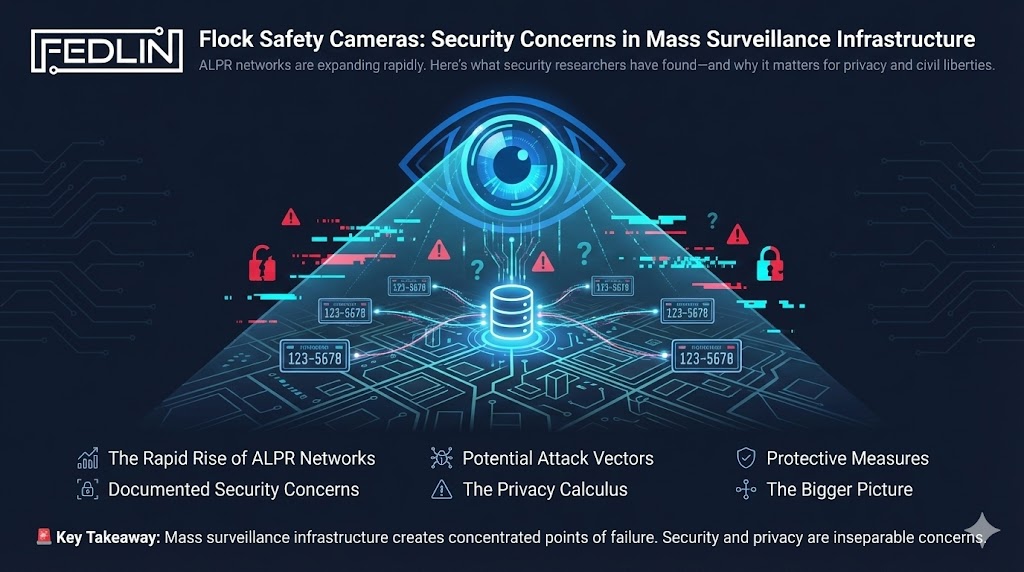
Flock Safety Cameras: Security Concerns in Mass Surveillance Infrastructure
ALPR networks are expanding rapidly. Here's what security researchers have found—and why it matters for privacy and civil liberties.
⚖️ Disclaimer: This article is for educational and awareness purposes only. The information presented is intended to help security professionals, researchers, and citizens understand the privacy implications of mass surveillance technology. We do not endorse, encourage, or condone any illegal interference with surveillance systems, unauthorized access to data, or circumvention of security controls.
Have you been noticing those small blinking red lights on the side of the road when you're driving home in the evening? They're easy to miss at first—a quick flash on a utility pole, a box mounted near an intersection, a steady pulse along a residential street. Then you start seeing them everywhere. You might have wondered what they are, or assumed they were some kind of traffic or municipal sensor. In many places, they're something else: automated license plate readers—part of a rapidly expanding network that tracks every vehicle that passes by, 24/7, often with no warrant and no individual suspicion required.
Those blinking lights belong to systems like the ones built by Flock Safety—one of the largest providers of this kind of surveillance infrastructure in the United States. Once you know what to look for, the scale of it is hard to unsee. Here's what's behind those lights, and why the security and privacy implications matter. We've cited primary sources throughout so you can see who said what; for a clear visual explainer, we recommend Addy LaMarr's video on the subject (linked in Sources).
Part 1
The Scale of Flock’s Network
Flock Safety has quietly become one of the largest surveillance infrastructure providers in the United States. Their Automated License Plate Reader (ALPR) cameras are deployed across thousands of neighborhoods, cities, and police departments—creating an interconnected web of vehicle tracking that operates 24/7 without warrants or individual suspicion.
As of 2024–2025, Flock operates cameras in over 4,000+ cities across 40+ states (by some counts, 5,000+ communities in 49 states), with their network capturing billions of license plate scans annually. [Wikipedia] Each camera captures not just plates but vehicle make, model, color, distinguishing features, and precise timestamps—building a comprehensive movement database. Flock also offers Condor PTZ cameras that record and track people, not just vehicles, including facial recognition–capable systems. [404 Media]
⚠️ The Scale: Flock's network can track a vehicle's movements across jurisdictions, creating a persistent location history—often without the driver's knowledge or consent.
Part 2
Documented Security Failures
In late 2025, 404 Media reported that Flock had left at least 60 of its AI-enabled Condor cameras exposed to the open internet—livestreams and admin panels with no password or login. Anyone could watch feeds (playgrounds, parking lots, streets), download up to 30 days of video, and change settings. The exposure was discovered by YouTuber and technologist Benn Jordan and shared with security researcher Jon "GainSec" Gaines; 404 Media verified by having a reporter stand in front of a camera in Bakersfield while colleagues watched the feed remotely. [404 Media] [SFist, Jan 6, 2026]
Immediately, we were just without any username, without any password, we were just seeing everything from playgrounds to parking lots with people, Christmas shopping and unloading their stuff into cars. I think it was like the first time that I actually got like immediately scared … I think the one that affected me most was the playground. You could see unattended kids, and that's something I want people to know about so they can understand how dangerous this is.
Benn Jordan
YouTuber and technologist, to 404 Media
Flock called it "a limited misconfiguration on a very small number of devices" that had been remedied; the company did not say how many devices were affected. [404 Media] Security researchers and investigative journalists have raised broader concerns about Flock's infrastructure:
- Data Access Controls: Reports indicate inconsistent access logging and limited audit trails for who queries the ALPR database and when.
- Network Sharing: Flock's "Hot List" and inter-agency sharing features allow data to flow between jurisdictions with varying privacy policies.
- Retention Policies: While Flock claims 30-day retention, police departments can request extended storage, and "flagged" vehicles may be retained indefinitely.
- Physical Security: Cameras deployed on public infrastructure may be vulnerable to tampering, interception, or manipulation. Independent research has documented some Flock ALPR models being compromisable in under 30 seconds via a physical button sequence.
From a security research perspective, ALPR networks also present theoretical attack surfaces: network interception if transmission isn't encrypted end-to-end; credential abuse from shared logins or weak authentication; firmware exploitation on IoT devices; data poisoning via adversarial inputs (spoofed plates, reflective materials). [Medium] [Flock] We encourage responsible disclosure for any specific vulnerabilities discovered.
Part 3
Privacy, Mass Surveillance, and Related Reading
Beyond technical vulnerabilities, ALPR networks raise fundamental privacy questions:
- Dragnet Surveillance: Every vehicle is scanned, not just those suspected of crimes—inverting traditional investigative principles.
- Location Tracking: Aggregated ALPR data can reconstruct detailed movement patterns, revealing sensitive information about individuals' lives.
- Mission Creep: Systems deployed for crime prevention often expand to other investigative or administrative uses beyond their original purpose.
- Chilling Effects: Knowledge of pervasive tracking can make people think twice about ordinary movement—where they drive, when, and how often.
In June 2024, a Norfolk, Virginia judge ruled that collecting location data from ALPR cameras constitutes a Fourth Amendment search and cannot be used as evidence without a warrant. [Wikipedia] The ACLU and EFF have long documented ALPR overreach and litigate for stronger safeguards. [EFF]
Ecosystem integration: Companies like Palantir market platforms that integrate this kind of technology into broader data-fusion and analytics. Palantir's Foundry is described in the company's own documentation as a data-integration backbone that connects "all types of source systems" (structured, unstructured, semi-structured) into a unified environment; Gotham is used by law enforcement for intelligence and decision-support. [Palantir, Foundry data integration] Reporting has documented law enforcement use of Palantir to combine license plate reader data with other sources—e.g. the LAPD's use of Palantir systems for ALPR and vehicle tracking. [BuzzFeed News] When fusion platforms pull in ALPR feeds, hot lists, and other datasets, dispersed camera networks can function as a single searchable dragnet. Analysts have framed the combination of Flock-style ALPR with Palantir-style fusion as a "digital dragnet" that expands the scale and reach of mass surveillance; there is no indication that Flock and Palantir are directly integrated, but agencies may use both. [PowerMentor] [Take Back Our Tech]
Related: Mass surveillance and who controls the infrastructure are themes we've written about elsewhere. Our post Anthropic, OpenAI, and the Government walks through how vendors respond when governments pressure them—and why bulk collection and domestic surveillance matter for risk and civil liberties. The same questions of scale, access, and accountability apply to both AI and physical surveillance networks like Flock.
Part 4
Protective Measures
While completely avoiding ALPR surveillance is nearly impossible in urban areas, there are steps individuals and organizations can take:
Attend city council meetings where ALPR contracts are discussed. Many jurisdictions now require public hearings before deploying surveillance technology.
File public records requests to understand your jurisdiction's ALPR policies, data retention periods, and access logs.
Organizations handling sensitive work should include ALPR awareness in their threat models and operational security planning.
Bottom Line
Flock Safety cameras represent a broader trend: the privatization and rapid expansion of surveillance infrastructure. Unlike government systems subject to constitutional constraints, private surveillance companies operate in regulatory gray zones. Security isn't just about protecting data—it's about ensuring technology serves human values. As surveillance systems proliferate, understanding their vulnerabilities and implications becomes essential for informed civic participation.
🚨 Key Takeaway: Mass surveillance infrastructure creates concentrated points of failure. A single breach could expose the movement patterns of millions. Security and privacy are inseparable concerns.
We encourage responsible disclosure for any specific vulnerabilities. This article is for educational and awareness purposes; we do not endorse illegal interference with surveillance systems or unauthorized access to data. The links below are the primary sources so you can see exactly what was reported and when.
Sources
Primary reporting, research, and explainers. Quotes in the article are from the cited sources.
- 404 Media, "Flock Exposed Its AI-Powered Cameras to the Internet. We Tracked Ourselves" (Benn Jordan, Jason Koebler) — Dec 2025
- SFist, "Report: Flock Safety, Maker of SF’s License Plate Reader Cameras, Had Gobsmacking Security Flaw" — Jan 6, 2026
- Wikipedia, "Flock Safety" (scale, Norfolk ruling, Condor)
- Flock Safety, "Has Flock Been Hacked?"
- Ali Gündoğar (Medium), "Vulnerability Assessment and Intelligence Estimate of the Flock Safety Surveillance Network"
- EFF, Automated License Plate Readers
- Palantir, Foundry Data connectivity and integration (official documentation)
- BuzzFeed News, "Scars, Tattoos, And License Plates: This Is What Palantir And The LAPD Know About You"
- PowerMentor, "The Digital Dragnet Debate: How Palantir, Flock ALPR, and Dataminr Can Help Save Lives—and How They Can Also Track Everyone"
- Take Back Our Tech, "Palantir for Cars (Flock Cameras) Roll Out in US Hardware Stores"
- Addy LaMarr — Video explainer on Flock Safety and ALPR surveillance (recommended); link goes to her YouTube channel.
- Related on this site:
- FEDLIN Blog, "Anthropic, OpenAI, and the Government" — mass surveillance, vendor pressure, and risk
Concerned About Your Organization’s Exposure?
We help organizations assess surveillance risks and implement protective measures as part of comprehensive security engagements.
Discuss Your Security NeedsNot sure where your security posture stands?
Start with a scoping call. We map your exposure across web, email, credential, AI, and breach history, and sequence the work into a prioritized plan with a Year 1 roadmap, built around what your architecture requires.
Subscribe to Security Insights
Get enterprise security tips, compliance guides, and best practices delivered to your inbox.