Encryption You Can Prove to a Customer
A customer's security questionnaire is the moment someone asks you to prove your encryption. Here is how to answer the cryptography section of the CAIQ, with the artifact that backs each answer.
The short version
- 1.One section of the questionnaire holds up the deal: encryption. It asks for names, numbers and dates.
- 2.Three jobs own the answers. Running your systems, managing your vendors, and owning your policies. One or two people often hold all three.
- 3.A specific answer with proof behind it clears the review. A vague one invites another round of questions.
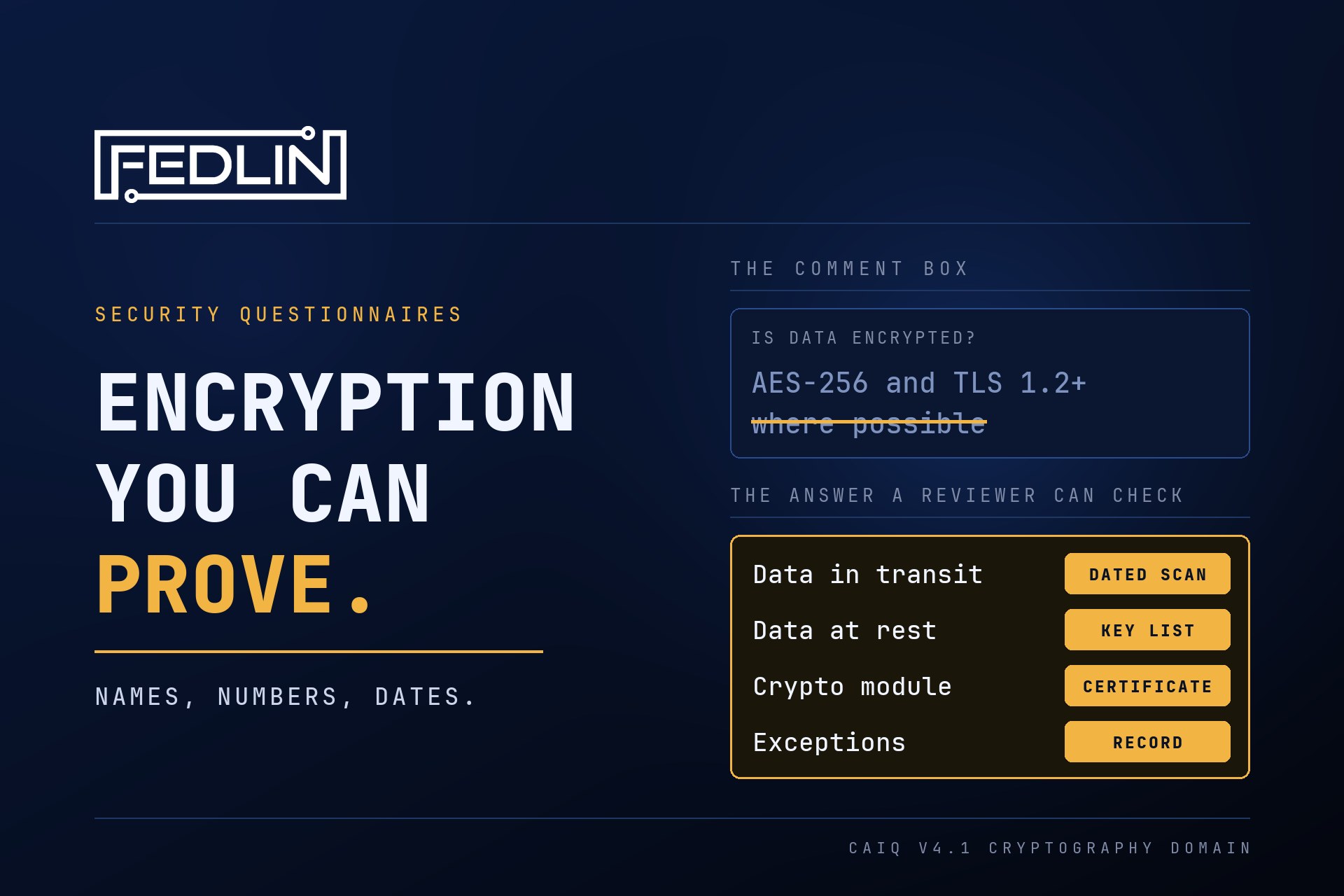
You get the security questionnaire on Monday. The encryption section is due Friday, and a deal is waiting on it. Every question has a Yes, No or N/A field and a comment box, and the field takes a second to fill in. The comment is the part a reviewer can check, and it is where an encryption answer goes vague: "AES-256 and TLS 1.2+ where possible" names no system, no key owner and no date. I think "where possible" is the first phrase to strike from any answer, because it names no exceptions and hides every system outside it. The question is not whether you encrypt. The question is whether a reviewer can check it.
This page is for whoever the questionnaire lands on, often before anyone knows who should answer it. It starts with finding the owners, then covers what the section asks, and ends with what to ask your team and your vendors. Your customer may have sent a spreadsheet of their own, the CAIQ, a SIG or another standard form. Whichever it is, the encryption questions cover the same ground: how data is protected, who holds the keys and how they change. This page uses the CAIQ because its numbered questions can be cited. Each part closes with the detail your engineer will want, set apart so you can skim past it.
Who Answers What
Each answer has an owner, and finding them is the first job. Name them before the questionnaire is split up.
- →Whoever runs your systems holds the list of keys, the protocol versions, the rotation settings and the key procedures.
- →Whoever manages your vendors collects the written reply from every provider that holds keys or does the encryption for you.
- →Whoever owns your policies supplies the documents, their owners and review dates, and the record for each No.
You sign off on every No and every answer still waiting on a vendor, because each one commits the company to a date.
Many companies have no dedicated security person, and those three jobs belong to one or two people with other work. That is workable if you narrow the first pass. Start with the three technical questions. Your cloud or hosting provider's console can show many of the facts, and your managed IT provider can answer the rest in writing, so send them the vendor email below as written. For the governance questions, a short written policy with an owner and a review date goes a long way, and a dated No covers the rest. If the list of keys is more than one person can build next to a day job, that is the point to bring in outside help for a defined first pass, such as a fractional security lead or an engineer who builds the list and the evidence alongside your team.
What the Section Asks You to Prove
The section checks how you handle the keys that lock your customers' data. Most of it is about process: who owns the keys, how they change, and what you do when one is lost. Three questions are technical. They ask whether data is protected while it is stored and while it moves, whether the methods are strong enough for the data, and whether the keys come from approved sources. One more, how often keys are replaced, can be backed by a setting.
For your engineer
In the Cloud Security Alliance's CAIQ v4.1.0, the current version, the cryptography, encryption and key management domain (CEK) has 21 controls and 23 questions, the same as in v4.0.3. The technical three are CEK-03.1 (data protection), CEK-04.1 (algorithms) and CEK-10.1 (key generation). CEK-12.1 is the rotation question. A table at the end maps all 23 to the sections below.
IDs and structure are from the Cloud Security Alliance Consensus Assessments Initiative Questionnaire Version 4.1.0 (the cryptography domain is unchanged from v4.0.3), with the wording paraphrased. Shared Assessments' SIG is licensed, so this page stays with the CAIQ.
Start With a List of Your Keys
Every other answer comes from one list: each key and certificate your company holds, what it protects, who owns it and when it last changed. If the list does not exist, building it is the first job.
For your engineer
The inventory question (CEK-21.1) asks for a record of every cryptographic material and its status changes. A certificate list, a key list from your key service, and a record of the algorithms and libraries in your code and dependencies together make it. Six columns are enough to start.
| What it is | What it protects | Algorithm | Owner | Rotation and last change | Module and certificate |
|---|---|---|---|---|---|
| Production database key | Customer records at rest | AES-256 | [role] | [period], rotated [date] | [module], certificate [number] |
The audit questions (CEK-09.1 and CEK-09.2) ask that encryption and key management are audited in proportion to their risk exposure and at least annually, and this list is what gets audited. A cryptographic bill of materials is the machine-readable version. Our open-source PQC toolkit (Apache-2.0) can generate part of it from TLS endpoints, OpenShift routes, SSH configuration and source repositories. It does not yet read keys held in a cloud key service, so those rows still come from your key service or your vendor.
Answer the Data Protection Question
The reviewer wants four things in the comment box: how data is protected while it moves, how it is protected while stored and who holds the key, which tested cryptography does the work, and which systems cannot meet the standard. A specific answer to each clears the question. A vague one invites a follow-up.
| Dimension | A vague answer | A specific answer |
|---|---|---|
| Comment text | "Yes. AES-256 and TLS 1.2+ are used where possible." | "Yes. Public listeners accept TLS 1.2 and 1.3 only (scan dated [date], attached). Database, object storage and backups use AES-256 with keys in [key service], owned by [role]. Cryptography runs on [module], CMVP certificate [number]. Exceptions: [system], accepted [date], review [date]." |
For your engineer
The data protection question is CEK-03.1. A specific answer has these four parts.
In transit: the protocol versions. Name them for every listener that terminates TLS, and say whether traffic between your own services is encrypted too. NIST SP 800-52 Rev. 2, written for federal systems, requires TLS 1.2 and, since January 1, 2024, support for TLS 1.3, so "TLS 1.2 and 1.3 only" is a defensible answer to aim for. A dated scan is the evidence. If a scan flags TLS 1.0 or 1.1, the finding page covers the fix and the exception record.
At rest: the algorithm and the key owner. Say which algorithm protects which stores (databases, object storage, backups, laptops), and who holds the key: your cloud provider, you, or the customer. "Encrypted at rest" says only that a switch is on.
The module. CEK-03.1 asks for libraries certified to approved standards. In practice that points to a cryptographic module validated under NIST's Cryptographic Module Validation Program. Name the module, its version and its certificate number, confirm the certificate is active for the version you run, and say "validated" only when one exists. If there is no validated module, say so plainly, name the approved algorithms in use, and attach the provider's own attestation. A test that cannot fail only restates the provider's claim, so do not attach it as the evidence.
The exceptions. List each system that cannot meet the standard, with a treatment and a review date.
The algorithm question (CEK-04.1) asks whether the algorithm fits the data classification, so tie the answer to your own scheme: which data classes get which protection. The key-origin question (CEK-10.1) asks where keys come from. NIST SP 800-133 Rev. 2 says all keys are based directly or indirectly on the output of an approved random bit generator, and the NIST SP 800-90 series covers those generators. When a validated module generates your keys, the same certificate can support the CEK-10.1 answer.
Set a Rotation Period You Can Defend
The questionnaire asks for a number: how often each kind of key is replaced. Pick a period for each kind, write it down, and make sure a setting enforces it. Then record the date of the last change.
Website certificates renew on a clock the industry sets: 200 days today, 100 days for certificates issued from March 15, 2027, and 47 days from March 15, 2029. Someone has to own renewal, and someone has to be alerted when it fails. A wrong CAA record can turn that automation into an outage, and the finding page on missing CAA records covers it.
For your engineer
The rotation question (CEK-12.1) asks for a cryptoperiod, which is how long a key may be used before it is retired. NIST SP 800-57 Part 1 (Rev. 5, section 5.3.6) suggests a day or a week for a data key that handles heavy traffic, up to about two years for one that handles modest volumes, and up to three more years of decrypting old data after that. A private signature key has its own range in the same section: about one to three years, destroyed at the end of it. For a key that signs money movement, pick the low end.
The certificate limits come from CA/Browser Forum ballot SC-081v3 (certificates issued on or after March 15, 2026, 2027 and 2029). State the period for each key type, the setting that enforces it and the date of the last rotation.
Answer the Lifecycle Questions Once
Seven questions ask what happens to a key from creation to retirement, including when one is stolen. One written procedure can answer all seven. Date it, give it an owner, and point each answer at it. Pasting the same reassurance into seven boxes answers none of them.
For your engineer
The seven questions cover revocation, destruction, pre-activation, state changes, deactivation, archive and compromise (CEK-13.1 through CEK-19.1). The procedure should say who can revoke a key and how fast, how keys are destroyed and archived, how state changes are approved, and that a compromised key is used only to decrypt, never to encrypt.
If a question does not apply, such as hardware security modules when you use a managed key service, say why and name the service. An N/A with no reason reads as an unanswered question.
When a Vendor Owns the Answer
Some answers belong to a product you bought. A backup platform decides how backups are encrypted, where its keys live and which cryptography does the work. Nobody on your team can read that from your own settings, and a guess is the quickest route to a wrong answer. Ask the vendor in writing. A support case or an account representative's email counts as evidence, and the written reply is what you attach. You can forward this as written.
Subject: Encryption details for [product], needed for a customer security review
Hello [name],
A customer's security review asks how [product] protects our data. Could you send the following in writing?
- The algorithm and key length that protect data at rest, and the protocol versions for data in transit.
- Who holds the encryption keys (you, us, or a key service we control), and how often they rotate.
- The cryptographic module that does the work, with its CMVP certificate number, or a statement that none applies.
- The setting or version that turns each of these on, with the documentation page that describes it.
We will attach your reply to our answer, and we need it by [date]. Thank you, [name]
When the reply comes, check that it covers the version you run, and record the date you checked. Until it arrives, do not answer Yes. Say in the comment that you are waiting on the vendor and the date you expect the reply, and add the open question to your exception list. That is a better answer than a Yes you cannot source.
For your engineer
The CAIQ gives every question an ownership field from the shared security responsibility model, with six choices: CSP-owned, CSC-owned, 3rd-party outsourced, Shared CSP and CSC, Shared CSP and 3rd-party, and Not Determined. When you answer as the service provider, a backup or cloud vendor you rely on is usually 3rd-party outsourced: CSA's definition says the third party implements the control and you remain fully accountable. A control you split with your customer is shared. Not Determined is CSA's choice for when you cannot tell which party is responsible, and CSA recommends explaining it in the implementation description.
A certificate or attestation names a product, a version and sometimes an operating mode, so confirm yours matches, and read a setting from the platform that holds it where you can. A validated module inside the vendor's product belongs to the vendor: NIST's CMVP FAQ says a product that embeds one can say it uses a validated module, and cannot call itself validated. Name the vendor's module and certificate, and say whose it is. NIST also suggests asking the vendor for a signed letter that states the product incorporates a validated module, that the module provides all the cryptographic services in the solution, and the certificate number (FAQ SG-8).
What to Write When the Answer Is No
A No with a date is an answer. One question asks whether customers can hold their own encryption keys, and a SaaS product may not offer that yet. I think the strongest answer is "No. Keys are provider-managed today; customer-managed keys are planned for [quarter]." It holds up on the next question, and a Yes with no evidence does not.
For a system that cannot meet the standard, write the exception with its owner, its compensating controls and a review date. The post on compensating controls for legacy systems shows how to write that record so an assessor can follow it. The governance questions ask for the name of each document, its owner and its last review date, and if the encryption risk program is only partly in place, say which part.
Two answers go wrong when the document gets ahead of the practice. A policy should describe what you operate: if it promises a one-year rotation on keys your provider holds, rewrite it to say who manages each key and promise a period only for the keys you control. A compliance status line should say what is implemented and what is not yet true, because the lifecycle questions that follow test the claim.
What to Attach
Each specific claim needs one artifact behind it. This set covers the cryptography section.
- →A certificate and key inventory, with renewal automation noted.
- →A dated TLS scan of each public listener.
- →The key policy and rotation setting for each key type, with the date of the last rotation.
- →The module name, version and certificate number from the validation list.
- →The vendor's written reply, for each answer a vendor owns.
- →The cryptography policy, with its owner, approval and review date.
- →The exception record for any system that cannot meet the standard.
What to Ask Your Team This Week
Five questions get you most of the way to the answers. Ask them before the questionnaire is due.
- 1.Where is the list of every key and certificate we hold, and when was it last checked?
- 2.Which versions of TLS do our public systems accept, and when was that last scanned?
- 3.Who holds the keys for our databases and backups, and how often do they change?
- 4.Which of our answers depend on a vendor, and have we asked each one in writing?
- 5.Which systems cannot meet the standard, and who owns the exception for each?
If one of these has no straight answer, that is where the work starts. Start from what already proves it.
Security Questionnaire Encryption: Common Questions
What encryption questions does a security questionnaire ask?
In the Cloud Security Alliance's CAIQ v4.1.0, the cryptography domain has 23 questions, the same as in v4.0.3. Three are technical: how data at rest and in transit is protected, whether the algorithms fit the data, and where keys come from. The rest ask whether key management runs as a documented process, with owners, rotation, a lifecycle and an inventory.
Who is responsible for completing a security questionnaire?
Three jobs share the answers: running your systems, managing your vendors, and owning your policies. In a small company one or two people hold all three, and someone with authority signs off every No. A dedicated security person is not required for a first pass. Start with the three technical questions, ask your cloud and IT providers in writing, and bring in outside help for the key list if it outgrows a day job.
How do I answer 'do you encrypt data at rest and in transit'?
Say yes or no, then name the protocol versions from a dated scan, the at-rest algorithm and who holds the key, and the validated module with its certificate number if you have one. Give backups and traffic between your own services their own lines, then list each exception with a treatment and a review date.
Is AES-256 FIPS compliant?
AES-256 is an approved algorithm. FIPS 140 validation applies to the cryptographic module that runs it, and NIST's CMVP FAQ says the correct term is validated, so a vendor that claims only compliance has not put the product through CMVP validation. Name the algorithm and, separately, the module with its certificate number. If you don't operate a validated module, say so and attach your provider's own attestation. NIST's FAQ says that from September 22, 2026 only FIPS 140-3 validations remain on its active list.
How often should encryption keys be rotated?
State a period for each key type. NIST SP 800-57 recommends a maximum of about one to three years for a private signature key, and up to about two years for a data key that protects modest volumes. Web certificates are capped at 200 days today and 100 days from March 15, 2027.
What is the CAIQ and where do I get it?
The CAIQ is the Cloud Security Alliance's Consensus Assessments Initiative Questionnaire: yes or no questions that map to its Cloud Controls Matrix. Version 4.1.0, released in January 2026, is free to download from the CSA site, and the STAR Level 1 edition is the one submitted to the CSA STAR Registry.
The 23 Questions by Cluster
| Cluster | CAIQ IDs | What the reviewer checks | Covered above |
|---|---|---|---|
| Tracking and continuity | CEK-20.1, CEK-21.1 | A record of every cryptographic material, and the risk of losing control of keys | List of your keys |
| Algorithms and data protection | CEK-03.1, CEK-04.1 | Data at rest and in transit protected with certified libraries, and algorithms matched to data classification | Data protection |
| Key creation and rotation | CEK-10.1, CEK-11.1, CEK-12.1 | Approved libraries and random number generator, keys tied to one purpose, rotation on a calculated cryptoperiod | Rotation |
| Key lifecycle | CEK-13.1 to CEK-19.1 | Revocation, destruction, pre-activation, state changes, deactivation, archive, and rules for compromised keys | Lifecycle |
| Customer-managed keys | CEK-08.1 | Whether customers can hold their own data encryption keys | When the answer is No |
| Governance | CEK-01, 02, 05, 06, 07, 09 | Policies, roles, change management, a risk program and audits | When the answer is No |
Sources (checked 2026-11-23): Cloud Security Alliance, Cloud Controls Matrix and CAIQ (v4.1.0, released 2026-01-27);NIST CMVP FAQ;NIST SP 800-52 Rev. 2;NIST SP 800-57 Part 1 Rev. 5;NIST SP 800-133 Rev. 2;CA/Browser Forum ballot SC-081v3.
Findings library
Questionnaire due, and no one to own it?
We can be the cyber resource for the first one: build the list of keys with your team, collect the vendor replies, close what the scan finds, and write the evidence behind each answer. You keep every deliverable.
Subscribe to Security Insights
Get enterprise security tips, compliance guides, and best practices delivered to your inbox.