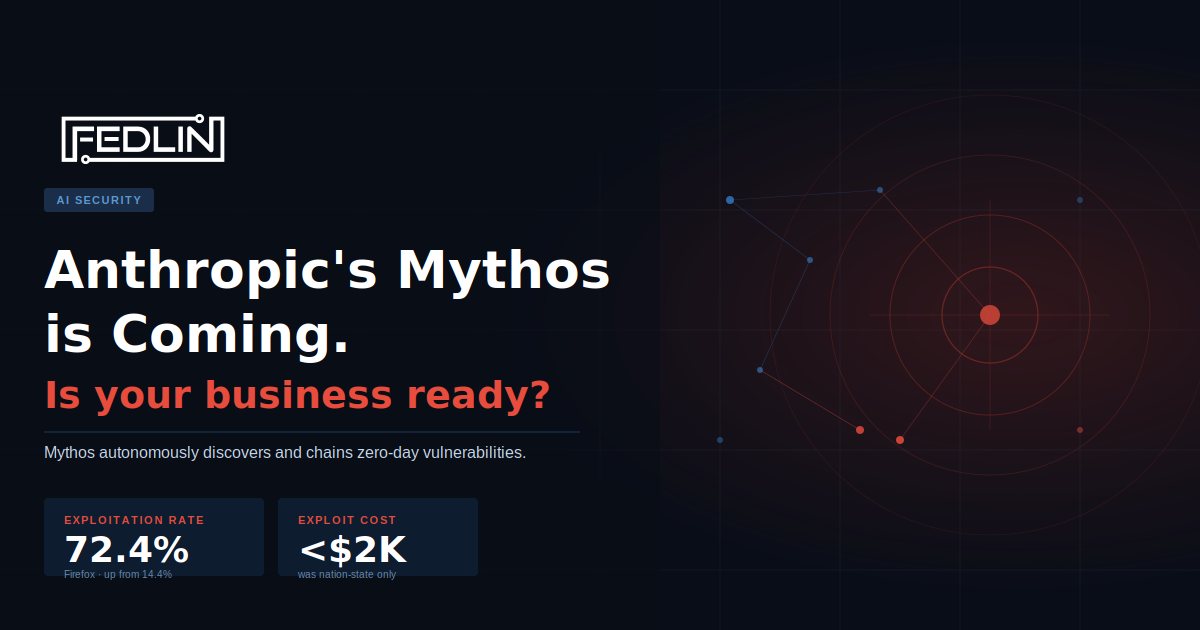
Anthropic's Mythos is Coming. Is your business ready?
Mythos autonomously discovers and chains zero-day vulnerabilities. The barrier to sophisticated exploitation has collapsed. The pool of actors who can target your organization has expanded to match.
The web application your team shipped last year is doing its job. No incidents, no alerts. The WAF was on the roadmap — deprioritized when the sprint filled. Security headers weren't configured at launch because the app wasn't handling sensitive data yet. There's nothing obviously wrong.
What nobody sees: an automated scan swept the asset the previous night. It found a reflected input that wasn't sanitized, a cookie without the HttpOnly flag, and no Content Security Policy to constrain script execution. Individually, none of those findings would make it onto a critical severity list. An AI exploit scanner chained them into a session hijack path in under an hour. By morning, an authenticated session belonged to someone else — and with it, every patient record, payment card, or internal document that session had access to.
The capability that made this possible is AI. Your organization's AI adoption is beside the point.
Anthropic released a preview of Mythos earlier this year. It's a general-purpose frontier model that turned out to be extraordinarily good at finding and exploiting software vulnerabilities — an offensive capability that emerged from broad gains in coding and reasoning, not a purpose-built design. The preview demonstrated that Mythos could autonomously discover zero-day vulnerabilities in major browsers and operating systems, construct multi-step exploit chains without human intervention, and do it at a success rate that puts it in a different category from anything that came before it.
Against Firefox, Mythos achieved a 72.4% exploitation success rate. Its predecessor managed 14.4%. It found vulnerabilities that had been hiding in production code for decades — among them, a 27-year-old bug in OpenBSD and a 16-year-old flaw in FFmpeg's H.264 codec. The model reasoned from vulnerability to working exploit on its own, with no human in the loop.
In testing across major operating systems and browsers, Mythos found thousands of zero-day vulnerabilities. At the time of disclosure, 99% remained unpatched.
This is a capability shift. Mythos targets the software your organization already runs — operating systems, browsers, the infrastructure every business depends on.
Anthropic has restricted Mythos to a closed group of critical infrastructure providers — Microsoft, Google, Apple, AWS, JPMorgan Chase, and Nvidia among the twelve launch partners, since expanded to more than 150 — describing it as the first AI model ever withheld from general release because of its destructive cybersecurity potential.
That restriction matters less than it might seem. Mythos is the leading edge of a capability class, not a single isolated model. The techniques it demonstrates — autonomous vulnerability chaining, AI-assisted exploit construction, rapid conversion of known CVEs into working exploits — are reproducible. The barrier to entry for this class of capability has already collapsed. The question is not whether Mythos itself reaches threat actors. The question is how fast comparable tools follow.
The attack surface is your stack.
Mythos finds and exploits weaknesses in operating systems, browsers, and the software infrastructure that every business depends on. AI adoption is irrelevant to exposure. A Mythos-class capability scans and exploits at a scale and speed no human attacker could match. Organizations operating on incomplete exposure maps and gaps in compensating controls are working from assumptions the current threat environment has invalidated.
The Probability Shift
Before Mythos, developing a reliable exploit from a known CVE required deep expertise, significant time, and access to infrastructure most threat actors couldn't afford. That barrier kept sophisticated exploitation largely in the hands of nation-state actors and well-resourced criminal organizations. If you weren't a high-value target for one of those groups, your practical exposure to this class of attack was low.
Mythos changes who can do this. Converting a known CVE into a working privilege escalation exploit now takes under a day. Zafran's analysis frames this as cybersecurity's Manhattan Project moment — the same capability that enables defenders to find and fix vulnerabilities now gives the long tail of opportunistic actors the power to find and weaponize them.
The attacker pool just expanded. When sophisticated exploitation required nation-state resources, the number of actors who could target your organization was small. When it doesn't, that number grows by orders of magnitude — and so does the volume of attempts against any organization with unpatched exposure. Any organization on the internet with unpatched exposure is in scope.
The Window Problem
Mandiant's 2026 M-Trends report added another dimension: exploits are now available a full week before patches are released — circulating while the patch is still in development. A vulnerability gets disclosed, and by the time a patch exists, working exploits have already been circulating for seven days.
Enterprise patching doesn't happen in seven days. It happens in weeks. Sometimes months. Testing, compatibility validation, change control, deployment windows — the operational reality of patching in production environments means that even organizations with mature patch management programs are running exposed for extended periods after a disclosure.
The Mythos capability shift and the disclosure-to-patch gap make the exposure window impossible to ignore. An organization whose security posture relies primarily on patching is operating on borrowed time between every CVE disclosure and its next maintenance window.
What Changes for Every Organization
Most security programs were built around a reasonable assumption: sophisticated exploitation requires sophisticated attackers, and sophisticated attackers have limited targets. That assumption is no longer reliable. The exploitation capability that previously required significant investment and expertise is now accessible to the long tail of opportunistic actors — targeting any organization with exposed systems regardless of size, industry, or perceived value.
The question every organization now faces is whether its security posture was designed for the threat environment of 12 months ago — or the one that exists today.
The gap this creates shows up in three places:
Unknown attack surface
Systems, services, and exposure points that haven't been formally assessed. A Mythos-class capability scans at scale — it finds exposure points regardless of how obvious they are.
Missing compensating controls
Network-level blocks, WAF rules, endpoint policies, and segmentation that operate during the disclosure-to-patch window. These controls exist to absorb the exposure period that patching alone can't close.
Undocumented security posture
Controls that exist in some form but haven't been mapped, tested, or documented against a framework. When the threat environment changes, knowing what you have — and where the gaps are — is the starting point for responding to it.
Who This Hits Hardest
The greatest exposure belongs to those who never considered security at all — a personal site running unpatched WordPress, a small business whose web presence was set up by a contractor years ago and never touched since. No WAF, no security headers, no one watching. Mythos doesn't require a sophisticated target. It requires an exposed one.
Within the world of organizations actively managing security, the capability shift lands unevenly. The amplifying factors are less about size than about the gap between how fast an attack surface grew and how rigorously controls kept pace. The segments below are where we focus our security and compliance engineering work — and where that gap tends to carry the highest operational and regulatory stakes:
Growth-stage companies pursuing enterprise deals or government contracts
Enterprise procurement and agency contracting officers run security reviews before signing. Those reviews ask for documented controls, mapped attack surfaces, and evidence that gaps have been identified and addressed. A company that built fast and iterated often has functional security in practice — but nothing written down that maps to NIST CSF or NIST 800-53. When the questionnaire arrives, the answer is someone's memory of how the system was designed. That gap doesn't just delay deals. In the current environment, it signals to a buyer that a vendor's security posture hasn't been stress-tested against an elevated threat model.
HealthTech and healthcare-adjacent organizations
Patient data makes these organizations high-value targets. The HIPAA Security Rule overhaul scheduled for 2026 eliminates the addressable/required distinction that let organizations defer controls based on cost and complexity. Every technical safeguard becomes required. That change lands in a threat environment where exploit development costs have collapsed. Organizations that have been carrying deferred controls under the "addressable" flexibility are now facing a deadline — and the Mythos release is a signal that the threat environment won't wait for it.
Defense contractors and state agencies working toward CMMC Level 2
CMMC Level 2 self-attestation is ending. Third-party assessors will verify controls against NIST SP 800-171 — and they'll want documented evidence that those controls are operating, not assertions. A Mythos-class threat raises the stakes of what those controls need to withstand. An organization that completes its CMMC assessment with compensating controls that haven't been tested against the current threat model has documentation that satisfies the auditor but may not reflect actual posture.
Organizations with active cyber insurance
Underwriters have been tightening requirements for years. Mythos gives them another basis for scrutiny at renewal: organizations that can't demonstrate a documented gap analysis, identified compensating controls, and an evidence-backed security posture are increasingly difficult to price. In some cases they're being declined or quoted at rates that reflect the ambiguity. The answer to underwriter scrutiny is the same as the answer to procurement scrutiny — documented controls with evidence they're operating.
What "Ready" Looks Like
Readiness in this environment means knowing your gaps before an attacker finds them, having compensating controls that hold during the window between disclosure and patch, and a documented security posture that can be verified — by an auditor, an underwriter, or a procurement team — on demand.
The organizing frameworks that matter here are NIST CSF and NIST SP 800-171. NIST CSF is what enterprise buyers reference in procurement reviews and what the HIPAA Security Rule overhaul aligns to. NIST SP 800-171 is what CMMC Level 2 assessors verify against. A gap analysis mapped to those frameworks produces output that's useful across all three contexts — a structured picture of what controls are in place, where the gaps are, and what the remediation priority order looks like.
The organizations already working from a documented, framework-mapped security posture won't need to scramble when the next capability shift lands. They'll already know where they stand — and have the evidence to prove it.
Sources
Primary reporting and research cited in this article.
- Zafran, “After Mythos: Preparing for Cybersecurity’s Manhattan Project Moment”: exploitation cost data, M-Trends window analysis, compensating control framework
- Anthropic, Alignment Risk Update: restricted release rationale, destructive cybersecurity potential determination
- The Hacker News: 99% of Mythos-discovered zero days unpatched at time of disclosure
- Mandiant M-Trends 2026: exploit availability preceding patch release by one week
Close the Window Before the Next Disclosure
WAF rules and edge-level controls are the compensating control that operates during the disclosure-to-patch window — blocking known exploit patterns before the patch exists. FEDLIN's Edge Security service configures and tunes those controls against your stack, mapped to SOC 2 CC6.6 and CC6.1.
Not sure where your security posture stands?
Start with a scoping call. We map your exposure across web, email, credential, AI, and breach history, and sequence the work into a prioritized plan with a Year 1 roadmap, built around what your architecture requires.
Subscribe to Security Insights
Get enterprise security tips, compliance guides, and best practices delivered to your inbox.